Showing posts with label Relationships. Show all posts

Tuesday, August 28, 2012

Body Broken by Charles Drew

This is a great handbook to help Christians live out their Biblical beliefs in a world that opposes most of what we stand for.

One thing I found particularly insightful was the concept that we have to live by God's word only for ourselves.  It is not our job to make the world, or even other Christians, do so.  There is certainly a time when we must take a stand but we don't need to fight every battle.

I once had a friend who was so opposed to Sarah Palin running for the Vice Presidency.  Long after the election she was still completely incensed.  Apparently, by her own account, there was a big rift in her family over this debate.  And the thing is, she didn't even oppose Ms. Palin's positions or beliefs.   She was upset that Sara was a working mother.

Now, do I think a mother with children should be at home tending to their family?  Absolutely!  That is why I am where I am today.  If a mother comes to me for council on this topic I will certainly speak honestly and clearly from the Word of God and share my opinion.  However, is it my place to bring others to conviction?  No.  Absolutely, not!  No where in the Word are we told to  take on the job of the Holy Spirit.  In trying to do so we use up so much of our resources which could be better spent leading people to the Lord.  There are some people we may only have one opportunity to witness to.  Do we want to waste it on politics?

Let's consider this example for a minute.  What difference did it make to take such a vehement stand against the candidate?  Was it going to change Sara Palin's desire to be involved in politics?  Was it going to cause her to quit the race and go home to care for her child?  Was Mrs. Palin even going to know what this woman thought on the topic?  Probably not.  And worse, in making such a fuss on this issue, over which the every day Jane has no control, she caused division in her family, made herself look foolish and argumentative and in turn hurt her ability to share the Gospel with others.

We serve our God better when we carefully choose which battles are worth standing for and invest our energies in the ones that will make a difference to a lost and dying world.

Yes, God has a standard and as Christians we should find it and try to live it out.  However, is it plausible to expect the lost world to live by God's standards?  Sometimes, indeed, we need to fight for what the word of God says because it would lessen our ability to follow the Lord.  For example, earlier this year there was legislation coming to Maryland which would have negatively impacted our rights in home schooling our children.  I believe God has commanded us to raise our children in His word and, for this family, homeschooling is the means to do so.  This was stand worth taking because it would change the way I am able to obey my God.  We did what little we could to prevent those changes from taking place.  And it was effective.  

I am very much opposed to the same sex marriage bill that was passed in Maryland this year.  Homosexuality is clearly against God's word.  My family has worked diligently (and I am glad to say we were successful) to get the bill moved to the ballot this fall.  Even though I feel very strongly on this, if push came to shove I would not spend any time debating my belief with a gay person.  It would only alienate them and in no way help them to be saved.  And truly, although it does violate what I believe is God's plan for marriage, gays getting the title of married by this worldly government does not change who I am or what my marriage is.  There are more important battles to fight.  Just the same, I will cast my vote in the negative this fall.    

I hope that clearly illustrates what I got from this book... there are some things we should live out as Christians and there are some things we should also fight for because they challenge our ability to carry out the Lord's commands.  Mr. Drew helps us to know which are which and how to be most effective.

It is time for a FIRST Wild Card Tour book review! If you wish to join the FIRST blog alliance, just click the button. We are a group of reviewers who tour Christian books. A Wild Card post includes a brief bio of the author and a full chapter from each book toured. The reason it is called a FIRST Wild Card Tour is that you never know if the book will be fiction, non~fiction, for young, or for old...or for somewhere in between! Enjoy your free peek into the book!

You never know when I might play a wild card on you!


Today's Wild Card author is:

Charles Drew

and the book:

New Growth Press (February 1, 2012)

***Special thanks to Rick Roberson of The B&B Media Group for sending me a review copy.***

ABOUT THE AUTHOR:

Charles D. Drew received his education at Harvard (BA in English) and Westminster Seminary (M. Div.). He has pastored for thirty years in Virginia, Long Island and New York, all in university settings. He presently serves as the senior minister of Emmanuel Presbyterian Church, which he founded in 2000 near Columbia University. Drew speaks frequently to universities and churches and is also the author of A Public Faith: Bringing Personal Faith to Public Issues, An Ancient Love Song: Finding Christ in the Old Testament and A Journey Worth Taking: Finding Your Purpose in This World. He and his wife Jean, a science teacher at the Brearly School in Manhattan, have two married children and two grandchildren. Sailing and music are two of Charles' great loves.


SHORT BOOK DESCRIPTION:


In this updated and revised version of A Public Faith (NavPress 2000), Drew helps Christians to develop practical biblical convictions about critical social and political issues. Carefully distinguishing between moral principle and political strategy, Body Broken equips believers to build their political activism upon a thoughtful and biblical foundation. This balanced approach will provide readers-Democrats, Republicans, or Independents- with a solid biblical foundation for decision making. Drew even helps Christians of all political persuasions to understand how they can practice servanthood, cooperation and integrity in today's public square. With questions at the end of each chapter to help readers explore and apply principles, Body Broken will train believers to actively engage with political issues while standing united as a church.

Genre: Religion/Christian Life/Relationships


Product Details:
List Price: $15.99
Paperback: 208 pages
Publisher: New Growth Press
Language: English
ISBN-10: 1936768305
ISBN-13: 9781936768301


AND NOW...THE FIRST CHAPTER:

-->
Ch a p t er 1

First Principles


The Lord reigns, let the earth be glad; let the distant shores rejoice. Clouds and thick darkness surround him; righteousness and justice are the foundation of his throne. Fire goes before him and consumes his foes on every side. His lightning lights up the world; the earth sees and trembles. The mountains melt like wax before the Lord, before the Lord of all the earth. The heavens proclaim his righteousness, and all peoples see his glory. All who worship images are put to shame, those who boast in idols—worship him, all you gods!

Zion hears and rejoices and the villages of Judah are glad because of your judgments, Lord. For you, Lord, are the Most High over all the earth; you are exalted far above all gods. Let those who love the Lord hate evil, for he guards the lives of his faithful ones and delivers them from the hand of the wicked. Light shines on the righteous and joy on the upright in heart. Rejoice in the Lord, you who are righteous, and praise his holy name. (Psalm 97)

We are bound to disagree over politics, not just in the culture but in the church as well. I bump into this reality all the time. One such occasion occurred in early 2009 when I had two very different appointments back to back. The first was with a leader in my church who wondered why we did not talk more forcefully about abortion and homosexuality. He wondered why we were more likely to speak out on trendy New York City issues like justice and mercy than to speak out and even act on the issues he was concerned about. He wondered why, for example, if we were prepared to sponsor a march against hunger, we were not also prepared to sponsor a protest in front of an abortion clinic.

I met next with a Christian graduate student at Columbia University. She told me that she had begun to drift away from Christian community because, as she put it, “I am beginning to find that the people I agree with theologically are the people I disagree with so- cially.” The issues for her were, interestingly, the same as those mentioned in my first appointment—abortion and homosexuality, but especially the latter. She was in a different place on those issues. She was not gay herself, but she had a number of close friends who were, and her love for them made her feel at odds, given her prior church experience, with the Christian community. She was confused about what the Bible had to say about committed homosexual partner- ships, and she was struggling over what she would do if she became convinced that the Lord forbade them.

We talked about many things—about the false choice the culture often presents (one either must completely accept the gay lifestyle or one must admit to homophobia), about the tendency in the evangelical world to elevate certain sins over others (homosexual sin over heterosexual sin; or sexual sins over other types of sin, like greed or gossip), about the fact that there are different legitimate strategies for nudging our culture in the direction of sexual health (California ballot initiatives being only one of them), about the difference between struggling with sin and embracing sin, and about the difference between homosexual inclination and homosexual behavior.

I came away from the second appointment thankful and perplexed (more later on my perplexity). I was thankful that this young person had felt comfortable talking to me, for I am “the church” by virtue of my role as a pastor. I could not help but think that she approached me because our church did not, in its public face, fit the stereotype that she had begun to react to. We were committed, as she discovered, to a traditional view of marriage (heterosexual, monogamous, lifelong unions), but we were also keen to keep our “front door” open, so that people like her and her friends would feel comfortable coming in for serious and honest discussion.


Tensions in My Own Mind

We are bound to disagree, not only over issues, but over which issues to “go public” on. Committed Christians, sometimes in the same church, sometimes in the leadership of the same church, can easily find themselves at odds with one another on these sorts of issues.

Such tensions arise not only between us but within us. I mentioned that I came away from the second appointment perplexed. The graduate student’s struggles reminded me of how confused people are, especially young people, even church-raised young people like her, about God’s way of wisdom when it comes to sexual matters. I found myself asking if our church’s relative public silence on the issue was in fact the best policy. Certainly it helped keep our front door more widely open than it might otherwise be. It certainly gave rise to an important and nuanced discussion with one particular person that might otherwise not have happened. But what about all the others out there? What about those in my own church who might need a lot more guidance than they realize?

Issues Change, but Disagreement Continues

As I write, everyone is talking about the economy—but not everyone in my church agrees on what is to be done. Some believe that the government bailouts are necessary and good; some see them as a fiscal disaster and an inexcusable wink of the eye at gross moral failure.

Back in the 1980s the range of issues was broader, but Christians still found plenty to disagree about. Some members of my congregation rejoiced at the swing to the right. They saw the Republican triumphs in 1980 and 1984 as harbingers of moral, fiscal, and educational renewal. Others were less sanguine,  pointing with dismay to the new guard’s positions on, for example, gun control and the environment  as huge moral blind spots. (If they had been able to see ahead into the new century, they might have been equally appalled at the financial chaos brought upon the world by the new guard’s advocacy of the unregulated pursuit of wealth.) Some saw the fall of the Soviet Union as the vindication of free market capitalism and of policies aimed at its unfettered growth. Others joined Czech Republic President Václav Havel in his fear that the lifting of Soviet control would only invite new expressions of violence, not simply in the former Soviet bloc, but even at home:


The unnatural bipolar system imposed upon the world, which concealed or directly suppressed historical differences, has collapsed. And these differences are now manifesting themselves with sudden and nearly explosive force, not just in the post-Communist world but also in the West and many other areas of the globe. I fully agree with those who see in this reality the seeds of one of the most serious threats to humanity in the coming era.

Some today might argue that the “triumph” of capitalism,  and the growing disparity  between the rich and the poor that  has accompanied it, has been one of the sources of the rise of terrorism in the first decade of the new century.

Navigating Our Differences: Don’t Panic

How do we navigate all these differences? Surely it is by looking to the Scriptures for perspective and guidance. I have found Psalm97 to be very helpful in this regard. It calls our hearts back to their proper center and for that reason serves as a manifesto on “first principles” for Christian citizenship. The first of these first principles is that Christians need never panic, since our God rules everything: “The Lord reigns, let the earth be glad; let the distant shores rejoice” (Psalm 97:1)

Notice that “reigns” is a political word. It describes a king exer- cising dominion over his subjects, the ancient equivalent (roughly) of saying, “President  so-and-so sits in the Oval Office.” Of course verse 1 says much more. We elect American presidents for a brief time. Their “reign” is neither permanent, nor absolute, nor flawless, nor worldwide, whereas God’s is all four. His rule causes the “earth” to be “glad” and the “distant shores” to “rejoice” (emphasis added). Verse 9 declares his absolute sovereignty over all authorities, whether seen or unseen: “For you, Lord, are the Most High over all the earth; you are exalted far above all gods.” What an encouragement! What a source of confidence and joy for the believer! God is in charge absolutely.
Those who bemoan the moral and  social disintegration  of American culture are often right. But when they speak to us in such a way as to stir up fear and panic in our hearts, they are wrong. Our God reigns, and therefore we need not—we must not—be afraid as we exercise our civic responsibilities, no matter what seems to be going on around us.

Consider the damage panic can bring. First of all, panic impairs judgment. If we give in to the voice that cries “Act now, or our great country will be forever lost!” we will find ourselves demanding easy and quick solutions to our nation’s problems, when in fact there are no such solutions. Christians, more than any others, should know that no candidate, no platform, no party has all the answers. But fear makes it easy to forget this.

Panic breeds impatience not only with political process but also with people. It easily leads to browbeating and to polarization even in the church, the very place where God expects us to model the one community that will outlast all others. How quickly and tragically we accuse and demonize one another when we are afraid. Our hearts break over the killing of millions of unborn children, but are we really right to label every pro-choicer an advocate for murder and every woman who submits to abortion an accomplice in murder? What of the young woman who has been persuaded that the child within is not yet a child? (Note: God distinguishes in Scripture between premeditated killing of a person and accidental killing, a distinction which we find in our own law’s distinction between murder and manslaughter.

Abortion is, of course, premeditated, but for some people that act is not morally murder since they have been led to believe that what is aborted is not a person.) What of the person who votes pro-choice because she cannot see how the legal battle against abortion will succeed rather than because she is pro-abortion? Because panic cries “Do something right now, before it is too late!” it dehumanizes us in our dealings with each other. For me to understand my neighbor’s motives and reasoning takes time, the very thing panic cannot stand.

Panic can be used to justify falsehood. Some people, fearful of a religious takeover, have lifted Jefferson’s “wall of separation” idea out of its historical context and used it, dishonestly, to justify the silencing of the religious voice in every public place and discussion. (The language, which nowhere appears in the Constitution,  was used by Thomas Jefferson in an 1802 letter to a group of Baptists in Danbury, Connecticut, to justify federal disengagement  in religion while tacitly approving  state engagement.)  Promoters of creationist literature, fearful of the impact of the teaching of evolution upon their children, have sought to sneak their material into a Pennsylvania public school by doctoring the terminology of their manual without substantially altering its content. Still others, fearful of the secularization of schools, have promoted “stealth candidates” with a hidden agenda (say, school prayer). Such subterfuge usually backfires, causing the opposition to retrench even further. Worse, when employed by believers, it dishonors the God they claim to serve by using ungodly means (lying) to advance an allegedly godly end.

Panic displeases God. Fear is a matter of the heart, and our reigning King cares deeply and especially about our hearts, since it is from them that everything else issues (see Matthew 12:33–37; Mark 7:20–23). God cares about why we do something at least as much as he cares about what we do. Psalm 97 reminds us that, deep down, the fundamental tone of our lives must be joyful confidence in God’s sovereign reign, not fear: “The Lord reigns, let the earth be glad; let the distant shores rejoice. . . . Rejoice in the LORD, you who are righteous, and praise his holy name.” (Psalm 97:1, 12, emphasis added). When I choose political and social action because I am afraid, even if I can justify that action from Scripture, I am denying God at a deep level. I am acting from unbelief. I am taking his majestic name in vain.

The next time you find yourself driven by fear, or you hear a mes- sage that urges you to act out of fear, consider Jesus. Our Lord saw the desperate evils of life far more clearly than we ever will, and yet he never panicked. In The Waiting Father Helmut Thielicke wrote:

What tremendous pressures there must have been within him to drive him to hectic, nervous, explosive activity! He sees . . . as no one else ever sees, with an infinite and awful nearness, the agony of the dying man, the prisoner’s torment, the anguish of the wounded conscience, injustice, terror, dread, and beastli- ness. He sees and hears and feels all this with the heart of a Savior . . . Must this not fill every waking hour and rob him of sleep at night? Must he not begin immediately to set the fire burning, to win people, to work out strategic plans . . . to work . . . furiously . . . before the night comes when no man can work? That’s what we would imagine the earthly life of the Son of God to be like, if we were to think of him in human terms. . . . But how utterly different was the actual life of Jesus! Though the burden of the whole world lay heavy on his shoulders . . . he has time to stop and talk to the individual . . . By being obedient in his little corner of the highly provincial precincts of Nazareth and Bethlehem he allows himself to be fitted into a great mosaic whose master is God . . . And that . . . is why peace and not unrest goes out from him. For God’s faithfulness already spans the world like a rainbow: he does not need to build it; he needs only to walk beneath it.


Seek God’s Glory above Narrow Political Goals

Psalm 97 calls us to exalt a Sovereign whose reigning glory knows no national bounds. And this gives us our second “first principle”: our political activism must always serve God’s glory worldwide. In other words, model Christian Americans, like their counterparts in Brazil or Korea or wherever, set their hearts first and always on the promotion of God’s interests.

Psalm 97 makes this priority vivid. Verse 1 does not read, The Lord reigns; let Israel (or America) be glad! Nor does it read, The Lord reigns; let my family be glad! These groups must surely join the chorus, but the choir in view is far grander: “Let the earth be glad; let the distant shores rejoice” (emphasis added). Verses 6 and 7 convey the same idea: “The heavens proclaim his righteousness, and all peoples see his glory. All who worship images are put to shame, those who boast in idols—worship him, all you gods!”  (that is, all the different groups of people throughout the world [emphasis added]).

In the classic film Chariots  of Fire Olympic runner Eric Lid- dell courageously models this priority. When the Prince of Wales and a number of other powerful  figures press him to overturn his conscience-bound decision not to run on the Lord’s Day, he politely refuses. A singularly obnoxious  figure accuses him of arrogant dis
loyalty, saying, “In my day it was ‘country first, then God.’ ” Liddell fires back, “It is you who are arrogant! God made kings. God knows I love my country, but I cannot for the sake of that country do what God forbids.”

God’s glory, God’s victory, the revealing and acknowledgement worldwide of who he is, what he has done, what he is doing, and what he will do—this great purpose drives history. Each nation’s saga belongs to this larger one. The history of the United States, so full of God’s blessing and goodness, is not for that reason a special history unto itself. It belongs, together with the histories of Peru, Iraq, China, and Senegal, to his story.

There is a remarkable moment on the eve of the conquest of Jericho. Joshua meets a strange figure:


[Joshua] looked up and saw a man standing in front of him with a drawn sword in his hand. Joshua went up to him and asked, “Are you for us or for our enemies?”

“Neither,” he replied, “but as commander of the army of the Lord I have now come.” Then Joshua fell facedown to the ground in reverence, and asked him, “What message does my
Lord have for his servant?” (Joshua 5:13–14)

God is neither “for us” nor is he “for our enemies.” God is for himself—his own purposes and his own glory. What a moment this was for Joshua. He suddenly realized that he was in the presence of an army far greater than his own. Perhaps even more important he realized that to be the commander of Israel at the gates of Jericho did not automatically put him in the ranks of that army, and he fell to the ground. If this humbling reality was true for Joshua in the days of the theocracy (when God’s rule was located in the action of one particular human kingdom) how much more true must it be for us who have no special claim to be God’s people simply because we are Americans or belong to a particular political party or are the advocates of a particular plan for making our country a better place. My strong suspicion is that, if we could see what Joshua saw, a great deal of the self-righteous certainty that lies behind our political anger would dissipate, and along with it the anger itself.


America and the Kingdom of God

We can draw at least one implication from this great principle. Many of us have legitimate longings for our country. But our deepest longing must not be that America will be happy or prosperous or safe. Think about foreign policy. Our deepest longing as we think about U.S. activity in Iraq and Afghanistan cannot simply be that America will be protected from terrorism. It must be that our policy there will advance in those countries, if only in small ways, the sorts of things that please and honor Christ—things like justice, mercy, and evangelism. One of the tragedies of modern times  is that far too many Muslim people hate Christianity  because they equate it with American militarism. Or think about the American economy. Our deepest longing must not be (as so many hoped in early 2009) that the economic crisis would pass quickly, that people would star spending again, that foreclosures would drop off and employment would rise, and that the “bad guys”  (whoever they were—there was, of course, some disagreement about that) would be brought to justice.

We must keep reminding ourselves that a safe and rich America is not necessarily identical with the triumph of God’s agenda. Scripture teaches after all that God is glorified not only in his mercies, but also in his judgments. In Romans 1:18–32 Paul describes the social and moral disintegration of an ancient culture—a disintegration disturbingly parallel to what we observe in our own country today—from sexual chaos to greed-driven economic collapse. Paul says that this tragedy did not happen by chance, but was the work of God aimed at making known his holy anger: “The wrath of God is being revealed from heaven against all the godlessness and wickedness of people, who suppress the truth by their wickedness” (Romans 1:18). Like Jeremiah and many of the prophets, the Christian must be prepared to say with tears, “Lord, if you choose to glorify yourself in the failure of our thankless and decadent society (and I hope you do not), then so be it. Honor your name!” Our first love must be God’s will and honor, come what may.

We must embrace this difficult truth or we will blind ourselves to things about our country, past and present, Republican and Democrat, that have not pleased God. We must love our country, but we must have lover’s quarrels with it (starting with ourselves), for our citizenship is in heaven.


Imagine a world without the United States. An unsettling thought, as unwelcome and as unlikely as the end of their empire would have sounded to Roman citizens at the time of Augustus Caesar. But history and Scripture teach us that nations come and go, and there is no guarantee that America will exist forever. Our duration and stability are in fact anomalies in the saga of human civilization. All human governments will one day fail, and for that reason the Christian sets his deepest hope on the glory of God’s reign, not the survival of his country.

Hate Evil

We come now to a third “first principle” for civic life drawn from Psalm 97: Christians must hate evil. Abundant evidence for this principle occurs in the psalm: “Clouds and thick darkness surround him; righteousness and justice are the foundation of his throne. . . Let those who love the Lord hate evil, for he guards the lives of his faithful ones and delivers them from the hand of the wicked” (Psalm 97:2, 10, emphasis added).

“Clouds and thick darkness” surround God’s throne because he is morally unapproachable.  That is, he is absolutely holy and we are not. When we read that his throne rests on “righteousness and justice” we learn that every act of his sovereign rule arises from a character and policy that are good and fair. Because of who he is, God will neither act unrighteously nor tolerate anything unrighteous throughout his dominion.

We will consider hating evil more fully in Chapter 9 in our dis- cussion of integrity. At present notice two things about it. First, we are to hate evil, not people—not even evil people (like those “fiends” across the aisle in Congress!). It is the easiest thing in the world to demonize the opposition—to make an abortion activist or a pro-gun lobbyist the incarnation of all that we hate about what they advo- cate. We must not do this.

Here is the second thing to note. The mandate to hate evil is for us a double-edged sword. On the one hand it comforts us immeasurably to know that the God who reigns over everything is good. We can know that all that is right and true and lovely will one day be fully vindicated. On the other hand, this truth reminds us that God is on our side only insofar as we are on his (remember Joshua’s encounter with the angel): “Rejoice in the Lord, you who are righteous” (Psalm 97:12, emphasis added).

Who among us can be 100 percent sure, in anything, that God is fully on our side? Even in our most “Christian” moments, we as a nation never enjoyed the special relationship to God that ancient Israel enjoyed. (People have different opinions on how Christian we were once, though it is fair to say that there was a time when a Protestant Christian ethos dominated the culture.) Israel was a theocracy, the kingdom of God located in a human kingdom—something we have never been, despite the rhetoric of some. For this reason we must be wary of the sort of thinking that lifts an event or law out of ancient Israel’s civic life and tries to insert it wholesale into the contemporary  scene as “God’s will for America.” A sad example of this was the tendency of some in colonial times to identify the killing of American Indians with the conquest of Canaan.

And even if we were a theocracy, we would still need to be extremely cautious about identifying what is “of America” with what is “of God.” After all, for all its privileged status, not even Israel survived the righteous judgment of God when they turned from him. Patient and forgiving for many years, he nevertheless chastened his people, even to the point of exile. If Israel, who enjoyed “most favored nation” status, was punished for sin, can we expect an exemption?

It is a great mistake to think that all the good guys and all the best ideas can be found in one party, usually one’s own. If we hate evil we will watch for it close to home. And we will resist it close to home—in the ideas and strategies of our closest friends and allies (those whose errors we are most apt to overlook). We will never find ourselves buying into everything our party or activist group stands for. And for this reason we will always be a little bit lonely, a little bit out of sync with our fellows. This may be hard, but it will keep us humble—and that is always a good thing.


Making It Personal

1.     What social issues would you rather not talk about at church, or with Christian friends, or with any friend? Why?

2.     Recall a time when you or a friend made a political choice out of panic. Why did you panic? What did you do and what were the results? Why is panic in politics unwise? Why does it displease God?

3.     Psalm 97 teaches that God’s glory worldwide is the main theme of history. Romans 1 reminds us that God is glorified in judgment just as he is in mercy. Where do you see God’s mercy at work in American society? Where do you see his judgment? Talk to God about what you see.

4.     The final stanza of Katherine L. Bates’ famous song, America, reads in part: “America! America! God mend thine every flaw. Confirm thy soul  in self-control,  Thy liberty in law.” Scrutinize the political party or activist group that you feel the greatest affinity to. Where does it need mending? What can you do to contribute to that mending? How might your efforts make you lonely?


Monday, July 30, 2012

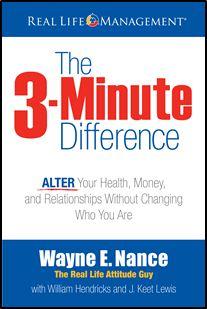
The 3 Minute Difference by Wayne E. Nance

I tell people all the time, it really isn't that hard to change your life and reach your goals if you are willing to make little changes.  That is the focus of this book.

Before I read the book, I took the quick survey in the link I received from the Publisher.  Point number one you should note... it really is quick.  I did it from my smart phone while nursing the baby.

Point number two... Usually those things are so very far off.  But I was shocked when this one got me dead on.

We are not all the same.  We don't all like the same things.  We all don't work the same.  When we try to fit into someone else's mold we end up feeling miserable and setting ourselves up for failure.  Often I think we find it difficult to make changes in our life ecause we are trying to do what works for someone else.  And sometimes that will work for us.  However, it isn't always the case.  By knwing who we are and how we work best we can set a plan for our life that will actually get us where we want to be.  Wayne Nance takes that into consideration.


It is time for a FIRST Wild Card Tour book review! If you wish to join the FIRST blog alliance, just click the button. We are a group of reviewers who tour Christian books. A Wild Card post includes a brief bio of the author and a full chapter from each book toured. The reason it is called a FIRST Wild Card Tour is that you never know if the book will be fiction, non~fiction, for young, or for old...or for somewhere in between! Enjoy your free peek into the book!

You never know when I might play a wild card on you!


Today's Wild Card author is:


and the book:

Mission Books; New Edition edition (July 1, 2012)

***Special thanks to Rick Roberson of The B&B Media Group, Inc for sending me a review copy.***

ABOUT THE AUTHOR:


Wayne E. Nance, better known as the "Real Life Attitude Guy", is the well-known developer of the ABCs of getting your life under control. He is founder and CEO of Real Life Management, Inc. With his help, more than 50,000 struggling people have successfully improved their lives and given Wayne credit for helping them do so. Top corporations, the U. S. Army, organizations, and churches throughout the United States also use the Life Management system for the benefit of their employees and leaders. Wayne has been called Dr. Phil Foxworthy, a funny guy with a serious message.

Today, Wayne is a highly respected speaker, trainer and author of The 3-Minute Difference, Mind Over Money and Liten Up for Life. He previously hosted "The Real Life Attitude Guy" simulcast on Dallas radio 570 (Fox Network) and is currently working to launch that programming on the Web. As president and CEO of Real Life Management, Inc., Wayne's life focus is to provide the education that he feels has been insufficient in matters pertaining to health, finance, relationship building and how they are related.

Wayne lives in Texas with Shannon and their three daughters, Christel, Melissa, and Kara.

Visit the author's website.

SHORT BOOK DESCRIPTION:


Are you overweight, broke, or headed for divorce? Even one of these problems can be personally devastating. But what if you're facing all three at once? Years ago, Wayne Nance's life was out of control.   An incessant smoker, he weighed 315 pounds.  His marriage was disintegrating and his finances were bottoming out.   He finally realized that his obesity, debt and relationship meltdown were surface problems resulting from his core attitudes and beliefs. In The 3-Minute Difference, Nance describes his journey back from the ragged edge of reality to a healthy, productive life. His personal journey uncovered a proven solution-a solution that can alter your health, money, and relationships in only three minutes.

The 3-Minute Difference is about more than just weight, money, and marriage. With the five insightful steps Nance offers for ALTERing your attitude, you can apply these principles to any area of your life that is out of control. Nance thoroughly explores each step, defining and explaining them in detail. Readers will come away with surprising, perhaps first-time ever insight into their own core attitudes and how they impact their beliefs and choices. The 3 Minute Survey is a valuable tool to use in improving life in the areas of finances, relationships and health. The 3-Minute Difference shows you where to start and then gives you a plan on how to get there."


Product Details:
List Price: $16.98
Paperback: 320 pages
Publisher: Mission Books; New Edition edition (July 1, 2012)
Language: English
ISBN-10: 1618431188
ISBN-13: 978-1618431189


AND NOW...THE FIRST CHAPTER:


INTRODUCTIOA Crisis in America


I want you to let your mind indulge in a little bit of fantasy for a moment.   Imagine yourself in a very successful career.  You’re making quite a bit of money—well into six figures. You’ve got a gorgeous 6,000-square-foot home with a fancy pool and a water- fall in the backyard. Parked in your three-car garage is an imposing Mercedes-Benz sedan. On your wrist is an enormous Rolex watch, the one with all the diamonds on it that dazzles everyone who sees it. Sound like a life you’d care to have?
It did to me. It’s the American Dream, after all. And in 1984, I had that dream and more. I was the kid from the poor side of the tracks who had raised himself up by his bootstraps, got a good education,  went to the big city, worked  hard,  and eventually met with success.
And you know what?  There’s not a thing wrong with that.  If that picture is similar to a dream you’ve always had, or a dream you’ve actually attained, I say, “Great! Don’t give up on that dream. Keep that dream alive.”
But know this: if you had seen me living that dream in 1984, you’d have said, “Wayne Nance has the perfect life.” But you’d have been dead wrong!  Because the truth is, my life was out of control. Meaning that I was making bad decisions that created serious long- term consequences for my happiness, health, wealth, and family.
Do you ever feel as if your world is spinning out of control?  A lot of us do in the post-9/11 world,  with  the economic  downturn that followed, the disaster of the stock market and the loss of many people’s  retirement funds,  the  ever-present  threat  of terrorist at- tacks,  the downsizing  of companies and  the offshoring  of American jobs, the erosion of values as corporate scandals have come to light,  and  so  many  other  things  that  make  us  worry  about  the future.
Those are serious matters, for sure. But did you know that there’s a crisis in America that actually affects more people on a practical, daily basis than any of those “world-class”  headline-grabbers? It’s a crisis that shows up all over the place but can be seen most graphically in three areas that all of us deal with every day: the lifestyle issues of food, money, and relationships. To put it bluntly, way too many Americans are fat, broke, and unhappy at home and at work.


Consider:
•   67 percent of Americans are estimated to be overweight or obese by Centers for Disease Control (CDC) standards.
• 85 percent of Americans will retire with Social Security benefits as their only means of support. In other words, they’re broke.
• 51 percent of Americans are divorced. Many others remain in marriages that might be called “psychological divorce.”
Clearly, something’s wrong in America!  Especially if you overlay those numbers on top of each other. Just imagine three pie charts showing the 67 percent of Americans who are overweight, the 85 percent who will retire virtually broke, and the 51 percent who are divorced.  Stack them on top of one another, and what do you see? That a lot of Americans are all three—fat, broke, and unhappy in their relationships. But that’s not the worst of it. The saddest thing is that many people struggling with one, two, or even all three of these problems don’t even think they have a problem!  Take obesity, for example. A 2004 Associated Press poll found that six people out of ten who qualified as overweight by government standards said their weight was just fine—healthy, even.
Or consider this observation from the national sales manager of a company  that  helps  small  businesses  and  individuals  facing bankruptcy work  out settlements  with their creditors:  “From  personal experience,  I see that  as people get further  into debt . . . they start making short-term decisions and don’t prioritize  their debt correctly.  Eventually, they start feeling overwhelmed, give up and go into denial.”1
What happens when someone goes into denial about their debt? They go deeper in debt.  They may also start eating.  Indeed, The Toque, a satirical Canadian website, imagines a VISA card issued by McDonald’s called (you guessed it) the McVISA. The idea is that people will be more likely to eat at McDonald’s if they can charge their Big Macs.
With that premise, the site invents twenty-two-year-old Josie Amblin, a student who uses her McVISA card at least ten times a week! “I can’t stop,” she confesses to a fictitious reporter. “It’s just so easy to purchase a burger and fries with credit.  I know I can’t afford to eat at McDonald’s this often, but I can’t help myself!”
Amblin racks up $2,100 on her McVISA card, even though it only has a $1,500 credit limit.
The whole story is a spoof, of course. But it hits the nail on the head. “I can’t stop! I can’t help myself!”  That’s the cry of someone whose lifestyle is out of control.   Someone who is making bad choices that will create serious long-term consequences for their happiness, health, wealth, and family.
In 1978, I was a poster child for being out of control in all three of the lifestyle areas I’ve mentioned. I weighed 315 pounds (that’s fat, by the way, even if you’re six feet, one inch tall). I was a financial advisor, but I had five credit cards maxed out. And at home, my wife, Shannon,  wasn’t exactly happy  with me because she and my daughter never saw me because I was too busy making  money for the family. At least that’s what I always told them (and myself): “I have to work this hard to provide for our family.” Yeah, right!
I was in total denial. I was caught up in a crisis that I didn’t even see. I was succeeding and making lots of money, and by society’s standards I was doing just fine. Only I wasn’t doing fine. You’re not doing fine when you can’t bend over and tie your shoes without being out of breath. You’re not doing fine if you’re giving great financial advice to other people, but your own financial condition is a house of cards just waiting to collapse. You’re not doing fine if you never spend time with your family because you’ve got to keep one step ahead of the hounds that are chasing you.
Because I didn’t have any boundaries, I let other people’s opinions determine my opinion of myself. I looked fine to them, so I thought everything about me was fine, too. But it wasn’t. My life was out of control.
Some people hit bottom and then finally wake up. I had to hit bottom three times before I woke up! (I’ve always known I was a slow learner.)  The first wake-up call came in 1978, when I was twenty-eight years old, with a beautiful wife, a one-year-old daughter, and another baby on the way. I was just at the point when a young man should be enjoying life to the fullest. Instead, my doctor was warning me that if I didn’t stop eating, I’d never see my fortieth birthday. Was that what caused me to change my ways? No! Guess what I did when I left his office? I headed straight across the street to a pancake house. I’m not kidding! And I charged the meal on a credit card. (You see, I do understand someone like Amblin!) So what was my first wake-up call? It happened during my annual visit to the “Big Men’s” store.  I was packing on so much weight that every year I needed new clothes—in the next larger size. You can imagine how embarrassing it was to make that trip. So it became my style to shift attention (and  blame) away from myself by complaining  about  the clothing manufacturers in Asia and how they were cutting their styles too small, or to joke that my wife was shrinking  my clothes in the washer.
But on one trip, when I started mouthing off, the old tailor spoke up. For ten years he had listened to my bull and said nothing. This time around he had had enough. He was getting ready to retire, so what did he care?  Right there in front of my wife, he turned to me and said, “It’s not your wife or the Taiwanese, pal. If you weren’t such a fat slob, you wouldn’t have a problem!”
I was stunned. I’d never been so insulted in my life. How dare him! Boy, was I ever mad! So I showed him. Why, I walked right out of that store without buying so much as a dime of new clothing!
But in truth, that guy did me a favor.  Because what he said was true. And it hit home. I was fat. Overweight. Obese. Whatever you want to call it, it doesn’t matter.  What matters is that I finally faced up to a cold, hard reality: my weight was out of control.
At some level I’d known that for years. But I had been in denial about it for years, too, really since I was a boy. You see, I come from a dysfunctional family on the outskirts of Houston, Texas (“dysfunctional” means you can get away with anything if you’ll just deny reality). Our family was the kind where Momma cooked everything in bacon grease. And if somebody  didn’t  have a third helping  of pie for  dessert,  she’d feel totally  offended.  But guess what?  In spite of Momma’s cooking there wasn’t a single “fat” person in the family. No, sir! We weren’t fat, we were just “big- boned.” That extra 50 or 60 or 90 or 100 pounds everyone was carrying was just the result of a “slow metabolism.” Just a “large thyroid.” And so Momma always told me that being fat just runs in our family. We had that “fat gene” going, don’t you know? (You see how denial starts early?)
With a background like that, it’s no surprise that early on I became the fat kid.  Eventually, the fat kid grew up to be the fat man. Only I wouldn’t admit that I was a fat man. I had all kinds of excuses to say I wasn’t. I was in total denial. “Justifiable denialism” is what I call it. I lied to myself to justify my poor decisions.  But the  scales don’t  lie, and  your  waist  doesn’t  lie, and  your  health doesn’t lie. And by the time I was twenty-eight I was getting sick and feeling tired.  And to be honest, I was sick and tired of being sick and tired.
So I did what almost everyone does when they finally accept the truth that they’re carrying too much weight: I went on a diet. In fact, I went on lots of diets. The grapefruit diet. The water diet. The low-carb diet. The six-meals-a-day diet. You name it, I tried it.
Sure enough, I lost weight.  And gained it back.  So I’d go on another diet, and lose weight. And then after I’d lost the weight, I’d quit the diet and I’d gain the weight back. Plus a little bit more. So I’d go on another diet, and lose the weight again. And then . . . well, you get the picture.
One diet I followed was Dr. Atkins’s first diet. He had two of them over the years. I tried the first one. He said if you ate about  as much  cheese and  eggs and  red  meat  as there  are  in the  state  of Texas,  you’ll lose weight.  I tried that and I did lose weight.  I lost about forty or fifty pounds, and pretty quickly.  But then I was diagnosed with a fissure tear in my colon, because I wasn’t eating any fiber or carbohydrates.
Surgery laid me up for a month.  And while I lay in that bed, I said to myself, “If I ever stop bleeding and get out of this bed, I’m going  to  learn  something  about  nutrition,” because  I had  never learned anything about it in school. I had been an athlete, but in my day the people in charge just said, “Eat chicken-fried steak, Wayne. You need something that’ll stick to your ribs. Don’t worry about the gravy. You’ll run it off.” I knew nothing about nutrition, food supplements, or how to balance my diet.
So when I got well, a friend told me about a book by Covert Bailey titled, Fit or Fat? Boy, was that a lucky break!  Bailey had a great concept: fat makes you fat. That was in 1979.  Amazing, isn’t it? Fat makes you fat. When  I read  that,  I realized  that  about  98 percent  of what  I was eating contained fat. I also discovered that when I wasn’t eating fatty foods, I was eating Oreos and chocolate milk and stuff that was loaded with sugar.
Bailey opened  my eyes to a lot,  and  I was shocked  to learn how  much  I didn’t  know  about  nutrition. After that, I couldn’t learn enough about it. I got really serious about what I ate, and I lost more than a hundred pounds over a two-and-a-half-year period.  All of a sudden I was the new thin guy. The 205-pound guy instead of the 315-pound guy.
So I’d gotten my life under control, right? Not exactly. I was only focusing on my weight. My spending was still out of control. Which means my work habits were out of control.  At 205 pounds I wasn’t  spending  any  more  time  with  my family  than  when  I’d weighed 315. I’d gone from being a big, fat, broke man with a lot of stress and an unhappy family to a thinner broke man with a lot of stress and an unhappy family.
Fast forward to 1984. By then, as I’ve said, I was making quite a bit of money.  I had the house, the car, the watch, the American Dream.  I sincerely thought I had it made. And I was thinner, too.
And yet . . . what difference does it make if you live to be one hundred if you’re miserable?  I was miserable.  I went through tremendous mood swings and depression.  I thought, “How can I be depressed when I’ve got it all?”
About that time I went on a trip to Philadelphia. I was now in insurance, and a very large insurance company wanted to honor me as one of its top ten salespeople in the country.  Quite an honor!  As I was riding on the bus from the airport to the hotel, we stopped at a red light downtown. I looked over and saw a big Catholic church. Suddenly tears started coming down my cheeks. I felt terribly sad. “I really don’t want to go to that hotel,” I was thinking.  “I just don’t want to go. I don’t want to be honored. I don’t want anybody giving me an award for being a guy that’s a workaholic who never sees his family, who just focuses on his money, his Mercedes, and himself. I feel very fake. I don’t feel good about this at all.”
But soon I was dropped off at the hotel.  Sure enough, I had my big private suite, all decked out with a complimentary fruit basket and a bottle of champagne. That was kind of cruel in a way, because I didn’t have Shannon there to enjoy it with me. The fact is, she had declined to come to the convention. She didn’t like being with me at that point in my life, because I was pretty much a jerk.
So there I was, the big shot in his big fancy room—all by his lonesome for a whole week. And boy, was I lonesome! So one day, right in the middle of the convention, I walked out of that hotel and went and found that Catholic church.  I’m not Catholic,  but I went inside and  ducked  into  a pew and  got down  on my knees,  and  I cried out to God: “Help  me understand why I’m so miserable!”
I didn’t really know what to expect. Nothing happened right away.  I finished the convention, collected my award,   and went home. About a week later, Shannon  told me that our girls’ elementary  school  was having  an open  house,  and  she wanted  me to go and  meet their  teachers.  I was still feeling kind of depressed, so I said I didn’t want to meet any teachers.  But for some reason I relented and went anyway.
My older daughter’s fourth-grade teacher had asked the students to make posters in answer to the question, “If you could have three things in your life, what would you want?” I looked carefully at the artwork arrayed on the bulletin board. Of the thirty-two kids in that class, twenty-six of them had drawn as the top three things they wanted out of life: more money, a sports car, and a big house.
Suddenly a light went off in my head. It was my second wake- up call. I thought about  those posters all the way home—driving in our Mercedes-Benz  to our six-thousand-square-foot home, driving past the other  six-thousand-square-foot homes in our subdivision, each with a Mercedes-Benz or sports car in its three-car  garage. By the time we arrived I had clarified my thinking.  “You know what?” I told Shannon.  “I’m miserable. I’m miserable because I’m trying to keep up with the Joneses, and I never wanted to be a Jones to start with. The worst of it is that we’re sending that message to our kids, and it’s the wrong message.”
Within  a year of that  night,  we sold the house,  got a smaller house in a different  neighborhood, I traded  in the Mercedes  for a pickup,  started  wearing  cutoffs,  and  got a Mickey  Mouse  watch made  of plastic.  I said to myself, “I don’t know where I’m going from here, but I’m going to refocus.” And in that  way I came to grips with  the fact that  my financial  lifestyle was out  of control, and  I needed  to  start  dealing  with  the  money  issue,  just  as  I’d worked  on the weight issue.
But I wasn’t out of the woods yet. Far from it. In 1992 Shannon and I hit rock bottom in our marriage. Remember,  I’d been in denial for years thinking  that  if I just provided  a nice lifestyle for my family,  they’d think  I was great.  Sure, we’d downscaled to a more modest home and all, but I was still providing well for my family.
But  one  day  Shannon   finally  decided  to  cut  to  the  truth. “Wayne, you’re basically a jerk,” she said. You can see that people sometimes have to shoot pretty straight in order for me to “get” what they’re saying.
At first I felt terribly defensive.  “Look at all I’ve done for you!” I thought to myself. “Look at all I’ve provided for us! Just look at all I’ve managed to accomplish in my life! Why, don’t you realize you’re talking to Wayne Nance here?”
But she was firm and clear: “I hate to tell you, Wayne, but you’re just a jerk. I don’t like you. And I hate to tell you the truth, but your kids don’t like you very much, either.”
That was yet a third wake-up call. Somehow the thought that the four people I cared about most in this world didn’t like me very much got my attention. “This isn’t working well,” I thought. “I started out fat, and I fixed some of that.  Then I started chasing money, and I fixed some of that. Yet now my family doesn’t like me very much. I think I better take a long, hard look at myself.”
So I did.  I went for counseling and had a lot of discussions over a long period of time. I came to grips with the fact that life is complicated. You can fix one thing about yourself, but that may only lead to problems with other things. The real question is, what’s driving your behavior? What’s the underlying  thing that’s creating all the  surface  problems  you’re  trying  to  fix? That core thing is what you’ve got to go after.
It was at that point that I encountered a powerful truth:  there is more to managing one’s lifestyle than merely making “right” choices. You see, almost  all the diets, budgets,  relationship books, and  other  lifestyle advice I had  gotten  said that  if I just made the “right” choices, everything  would  work  out.  Just eat less fat. Just stay within a budget.  Just tell your wife you love her more.  Just show up at your kid’s soccer game. Just count to five when the annoying person at the office pushes your buttons. Those were all the “right” choices. Do those and you’ll get your life under control.
Problem is, I’d made a lot of those “right”  choices. But my life still was not working.  Worse yet, I was having to put enormous energy into making “right” choices. So much energy, in fact, that if I let my guard down for an instant,  or if I felt tired or down or angry or whatever,  I’d just blow off my resolve and do it the old way— order  that  extra  meat patty  and the double  fries, buy that  tie that cost twice what  I intended  to pay, take on that  extra  speaking  engagement even though  I’d promised  Shannon  I’d be home that weekend.  Clearly, something else was contributing to my behavior besides making “right” choices, important as those were.
That’s when I encountered this breakthrough truth,  the truth that allowed me to start getting my life under control: most of what causes us to make the lifestyle decisions we make is not our choices, but  our  attitude  and  our  beliefs.  By attitude I mean the inborn “wiring” that we brought with us into the world.  Our attitude has to do with our basic outlook or orientation toward life, what we focus on, what matters to us, what we put our energy into. Attitude makes the biggest difference in our behavior.  Later in the book  I’ll take  you  through a simple  3-Minute  Survey that  will show  you your attitude, and I’ll tell you where you can get more information about  your “hardwiring.”
When I learned that the core of my lifestyle problems was my attitude, I started on a journey that continues to this day. I wondered, “Am I the only person in America who is struggling with food, money, and relationships?” What I discovered shocked me.
I began going to health spas and fitness centers, where I traded speaking and training for the opportunity to interview spa participants.  That gave me lots of firsthand data about the issues people really struggle with.
I found that millions of Americans are in crisis in those three areas.  In addition, I discovered that there is a link among those three issues—obesity, debt, and divorce. The link is people’s underlying attitudes. I discovered that certain attitudes are especially at- risk for obesity, debt, and divorce.  In other words, many of the same people who struggle with their weight and other health issues struggle with their money and related financial issues, and also struggle with their relationships, both at home and at work. They struggle because of their attitudes. And sadly, they don’t even realize that their attitudes are leading to self-defeating and self-destructive behaviors!
Would you like to know whether you (or someone you care about) are one of those people? Better yet, would you like to know how  you  can  regain  control  over  your  lifestyle,  no  matter  what your wiring may be? This book will help you do that.
First it will help you understand your attitude and how it affects everything you do and every decision you make.  Then it will take you through the same five-step plan that helped me lose more than a hundred pounds and keep the weight off for more than fifteen years.  The  same plan  that  helped  me pay off my five credit cards,  so that  today  Shannon  and  I live debt-free.  The same plan that has allowed Shannon and me to stay married—and increasingly happy—for thirty-one years.
Now let me point out that I have not written this book on my own.  This is a joint venture between me and my co-authors, Bill Hendricks and Keet Lewis. We decided  that  we would  write  the book  from  my  perspective,  using  the  first-person   singular  (“I,” “me,” “my”). But rest assured that this book expresses a common understanding among three partners. Indeed, Bill and Keet will tell you that they, too, have felt out of control at various times in their lives. They use this program daily to better manage their lives and businesses.
Bill understands the challenge of keeping life in balance, having lost his wife to breast cancer several years ago, and single- parenting his three daughters in their adolescent and teen years. Meanwhile he has headed  a consulting  practice  that  uses the phenomenon  of giftedness  to  work  with  businesses,  nonprofits, and churches to manage their strategic “people issues,” and with individuals seeking career guidance.
Keet has an extensive background in managing companies spanning several industries.  Today he is a busy entrepreneur with a variety of business and charitable activities.  He teaches the concepts in this book in his consulting work with companies, schools, and religious organizations. Like me, he has struggled at times with his weight and finances, and he has personally witnessed the success of our program.
Others have also contributed to the ideas presented in this book.  I’ve mentioned Covert Bailey’s influence on me. Keet first learned about attitudes from his friend, Zig Ziglar, who taught him that attitude is everything.  As Zig so aptly puts it in his foundational work, See You At the Top “Your  attitude determines your  altitude,” and  that  “we  can  Alter our  lives by Altering  our Attitudes.”
Keet began  his personal  dedication to understanding behavioral  science when,  as the CEO  of a manufacturing company,  he studied  and  applied  the principles  relating  to temperament as explained  by bestselling author Dr. Tim LaHaye  in his classic work, Why  You  Act  the  Way  You  Do.  Dr.  LaHaye wrote many other books on temperament, and they are a must read for any serious student of the subject. Additionally, Dr. James Dobson, Dr. John C. Maxwell, Dr. Steve Farrar, Dr. Howard Hendricks, Dr. Bill Bright, Josh McDowell, Dennis and Barbara Rainey, Dr. Tony Evans, Rich DeVos, Dr. Ron Jenson, Dr. Jack Graham, Judge Paul Pressler, and Bill Hawkins have all contributed much to our understanding of life- style issues like parenting, personal responsibility, and leadership through their very insightful writings. All of them have helped to lay a foundation for our work at Real Life Management.
Keet, Bill, and I hope that this book  will be a helpful complement  to the work  of people  like Bailey, Ziglar,  LaHaye,  Dobson, Maxwell, Rainey,  Jenson,  and  others  who  have pioneered  in the field of attitude and lifestyle management. Above all, we want this book to offer hope.
If I was able to regain some control of my life, you can do the same, no matter how desperate you feel your life has become. I’ve helped countless people just like you over the years through my training  workshops and  seminars  at corporations, health  spas, financial planning  firms, universities,  churches,  and many other  settings. Almost all of the folks I’ve met have tried way too many of the quick-fix diet, budget, and relationship gimmicks on the market. Most of them were discouraged. A lot of them were desperate. Some had even given up.  “I’ll never change!” They said.  If that’s how you feel, I implore you to keep reading. Because I’m not going to ask you to change.
You read that right. I’m not going to ask you to change. The word “change” implies that you need to make a 180-degree turn- around and basically become someone other than who you are. I’ll never ask you to do that.  God wired you the way you are, and I’m fine with that. I want you to be fine with that, too. You are just fine the way you are! But I know you’re not happy with the way you live. So come on inside this book with me, because I’ve developed a proven strategy to help you turn your life around.