Showing posts with label Self-Help. Show all posts

Wednesday, December 18, 2013

Hot Buttons, the Bullying & Image editions, by Nicole O'Dell

Click here to buy on Amazon.com
 Ms. O'Dell, in this series of books, encourages parents to not only face head on the issues that arise with adolescence, but to intentionally open conversations and resolve the issues that face modern teens and pre-teens before they crop up. She clearly discusses the big, taboo questions from "How do you feel about how you look?" to "Have you ever looked down on someone because of their looks or abilities?".

The first part of the book tells us the importance of pro-active, open communication and why it is important to each of these topics. This section is interlaced with testimonies from the author's life, and real-life responses of teens.

The next section is the work manual, the hands-on guide to communicating clearly, which Nicole calls "pressing the hot buttons."
This section is filled with thought provoking questions and how to answer the answers. One key she always emphisizes, is to never, ever, react to what your teen says, but to act. This shows respect for their opinions and keeps communications open--the result being a teenager who is respectful of what you have to to say and is willing, wanting, waiting (thank you Mr. Doolittle), to communicate with you. If the lines of conversation stay open and clear, you eliminate a lot of the issues caused by frustration. 

These are not easy questions, and a lot of thought and massive amounts of prayer should go along with the recommended exercises.

As for recommendations, these are great books for parents (for whom they were intended) or for teachers, counselors, and youth leaders.

There are several titles in this series: 

Hot Buttons: the 30-Day Challenge
The Bullying Edition
The Dating Edition
The Drug Edition
The Image Edition
The Internet Edition
The Sexuality Edition
 

Thursday, August 22, 2013

First Hired, Last Fired: How to Become Irreplaceable in Any Job Market by Anita Agers-Brooks

Whether you have been working for years or, like me, are preparing to enter the work force, First Hired, Last Fired is a fantastic book for any employee. Anita Agers-Brooks uses the lives of men and women in the Bible such as Joseph, Ruth, Deborah and Zaccheus to draw principles of how to become an invaluable employee. Applying these simple yet profound principles to your job will not only help build your career and life but will also make an employee stand out from among the crowd and make people wonder what you have that they are missing. Each chapter presents a tip for becoming an irreplaceable employee followed by a fictional account of a worker who didn't apply these principles and the jeopardy in which it placed their life and career. After exploring the chapter's theorem a little deeper, each chapter retells the same fictional story but this time with the character applying the guideline and the much different direction their future takes. As a manager Ms. Agers-Brooks' advice carries weight and it is informative to see what potential employers value and are looking for in their workers.
----------------------------------------------------------------------------------
It is time for a FIRST Wild Card Tour book review! If you wish to join the FIRST blog alliance, just click the button. We are a group of reviewers who tour Christian books. A Wild Card post includes a brief bio of the author and a full chapter from each book toured. The reason it is called a FIRST Wild Card Tour is that you never know if the book will be fiction, non~fiction, for young, or for old...or for somewhere in between! Enjoy your free peek into the book!

You never know when I might play a wild card on you!


Today's Wild Card author is:


and the book:

Leafwood Publishers (August 13, 2013)

***Special thanks to Ryan Self for sending me a review copy.***

ABOUT THE AUTHOR:

Anita Agers-Brooks is a business and inspirational coach, certified personality trainer, productivity specialist, certified team training facilitator, marketing specialist, and national speaker. She is a member of the Christian Writer’s Guild; graduate of Christian Leaders, Authors, and Speakers Seminars; co-founder of The StoryWriting Studio; and speaker on circuit for Stonecroft International Ministries. As a founding partner in The Zenith Zone, she’s dedicated to helping business owners, managers, and employees grow and thrive. She travels the country teaching others from her personal experiences and research.

Visit the author's website.

SHORT BOOK DESCRIPTION:

First Hired, Last Fired shows readers how to use the valuable wisdom found in the ancient text of the Bible to avoid becoming disposable in this challenging marketplace. Through timeless wisdom, simple solutions, and easy-to-apply principles, readers will find meaning in their work lives, and deep satisfaction from committing to a job well done. Through practice, the reader will learn to look deeper into the Bible for relevant help with current issues.


Product Details:
List Price: $14.99
Paperback: 224 pages
Publisher: Leafwood Publishers (August 13, 2013)
Language: English
ISBN-10: 0891123202
ISBN-13: 978-0891123200


AND NOW...THE FIRST CHAPTER:

The Joseph Factor


“Anyone can be replaced.” Often quoted, but is this an irrefutable truth? Or can someone become so valuable at work it’s hard to imagine anyone else doing the job? I asked these questions in a two-year investigation to find out why some employees are favored and why others are easily discarded.


As part of my search, I considered my own experience as a manager. I’ve encountered a few rare employees who demonstrated integrity to such a degree they became irreplaceable to me as a supervisor. I’ve fought to keep these people in my workforce, and, when they left, things weren’t the same. Whether they knew it or not, these savvy folks set themselves apart by following centuries-old patterns.


There are formulas for success proven through millennia of practice.
Irreplaceable employees dare to be different in a systematic way.


My examination of facts took me deep into the heart of the Bible. Whether you believe in this ancient text or not, it’s hard to argue against its time-proven wisdoms. In my research, I discovered more than eight hundred passages related to work or labor. I believe if we studied and applied them today, a powerful and united workforce could result.


Where debt buries us, untold riches await our unearthing. Instead of giving jobs away, nations would rise to a place of leadership in the world’s commerce. Pride would fall prey to humility rooted in a commitment of integrity. But it starts with the individual.


Let’s face it, many people believe they work smarter, harder, and better than their peers. But do their ethics, their productivity, and their attitudes support this belief? In today’s cynical world, can individuals still impact their job, family, community, nation, and the globe for a greater good? Can you become irreplaceable? I’ve seen the difference when people work God’s way and when they don’t. You get what you give.


Gary’s story is a prime example. For this book, I interviewed more than one hundred employees in various fields. The following fictionalized account portrays a compilation of a sad reality played out in businesses around the world. Let’s peek inside the mind of a man who believes he’s underappreciated and justifies his weak behavior.


--


The powerful scent of imitation leather and sandalwood caused Gary to sneeze. First Capital Mortgage Company’s board members were meeting tomorrow, which meant someone overdid the commercial air fresheners. Gary didn’t need cologne today. His clothes would smell of the earthy concoction by lunch.


He tried to smooth his rumpled shirt while he clocked in. The sound of male laughter caught his ear, so Gary made his way to the small group of huddled coworkers. He circled the group with a few friendly back-slapping and how-are-you greetings. Each man rewarded him with a varying degree of smile.


“Hey, are you putting money in the football pool or not? Everyone else is in, and the big game’s tonight,” Tom said.


  “Yeah, I’ll stop by your desk before I leave today, I promise,” Gary said.


“As usual, a man of many words, I’ll believe it when I see it.”


Gary’s hazel eyes sparkled and he cocked his right eyebrow, “Hey, I keep my promises.”


Tom opened his mouth to respond but shut it just as quickly. Their chief financial officer, Mark, stormed up the hall wearing a focused frown. The huddled mass broke, and most of the men scurried to their posts, hoping Mark wouldn’t note the inactivity. Gary wasn’t fast enough and stood frozen in position, waiting for the assault.


When Mark caught you doing anything but work, punishment followed. It might not be formal, and Mark might not address the situation directly, but his reactions said you were on his blacklist.


Sensing danger, Gary offered Mark a verbal to do list.


Red-faced, Mark said, “Don’t tell me what you’re going to do, just do it. I’ve been waiting on that report for three days now, and it had better be on my desk by 3 p.m. No excuses this time.” He barely broke stride as he marched off to find his next victim.


After Mark left, Gary shrugged his shoulders. He muttered while he walked, “If Mark would just listen and treat me like a human being I might be able to finish that report. Every time I try to tell him my plans he gets annoyed. He should appreciate me. I try a lot harder than some of the people who work here. He doesn’t have to be such a jerk. If I were running this company, I’d listen to people.”


For months, Gary had tried. Small talk about the family, flattering comments, and even gifts hadn’t worked with Mark. Every attempt met a terse, “Don’t you have work to do?”


“No matter what I say, he just doesn’t like me.” Disappointed but determined not to give up, Gary stopped muttering and whistled as he headed to his desk.


Once there, he grabbed his coffee cup and fell in step with Christy. They chatted briefly on the way to and from the office lounge. Fifteen minutes later, Christy headed to her own desk as Gary sat down to work. His mind wandered while he popped his earplugs in. He scrolled to the new album he’d downloaded last night. He needed to focus; Mark would have his head if he missed another deadline.


Gary started his daily routine. He checked e-mail, updated his Facebook status, checked the activities of his friends, and tweeted. Then he added charges to the expense voucher from his recent business trip, before preparing to get into the report Mark needed.


Gary typed two sentences when his iPhone vibrated. His wife, Denise, said, “Hi, honey, I just spoke with the plumber and he’ll be at the house tomorrow, can you take off?”


“I’m not sure. Mark’s really on me today. Can’t you do it?”


Denise sighed, “I’ll see, but if I’m gone tomorrow, I can’t leave in time to pick Emma up from practice tonight. Can you get her at five?”


“Yeah, I’m sure I can sneak out a few minutes early. Do you want me to get something for supper?”


A heavy breath signaled Denise’s relief, “That would be great. Oh, I’ve gotta go, here comes my manager. Love you.” The line went dead.


Gary put his phone back in his shirt pocket, clicked on Mark’s report, and then stopped. He realized he needed to check his bank balance. He pulled up the online information and got his checkbook out. He hoped there was enough to pay the plumber. A few minutes later, an assistant manager walked by, so Gary clicked on the overdue report until the coast was clear. He pulled his account back up and after a quick reconciliation was relieved to find there was enough money for the house repairs.


He looked at his watch and gasped. It was almost time for lunch, and he hadn’t even started that report. Beating back a twinge of guilt, Gary pushed hard for the next hour and twenty minutes. He even worked ten minutes into lunch to make up for the time he’d wasted in the morning.


The afternoon passed uneventfully. Gary finally put the last touches on his report just before two thirty. He sent a text to share the good news with his wife, and breathed deep with satisfaction. He wondered aloud, “Why do I put things off? It’s not so bad once I get started.”


Gary smiled sheepishly as Tonya walked by his cubicle and gave him a puzzled look. His outspoken musing must have been louder than he thought.


He celebrated the report completion by walking across the office to see Tom. They bantered about the upcoming play-offs. Tom challenged Gary with, “Put your money where your mouth is buddy, and give me five bucks for the pool.”


Gary chuckled as he dug the money out of his wallet. They were still laughing when Mark walked up behind Gary. The cloud on his face promised bad news.


“Th-tha-a-at report’s on m-my desk and ready to go.”


“Grab it and bring it to my office, I need to talk to you.”


Gary felt queasy as he walked the hall toward Mark’s office. He knocked on the door and entered at Mark’s terse invitation. As Gary sat down, he saw Connie, the human resource manager. Gary flinched when Mark shut the door behind them.


“Gary, we have to make cuts. There’s no way around it. The banking industry is suffering along with the rest of the nation in this recession. Positions must be eliminated, and yours is the first to go. Connie will help you clean out your desk. The necessary paperwork is done.
You will get two weeks of severance pay, and we certainly wish you the best of luck. I’m sorry.” Mark’s tone of voice wasn’t as soft as his final words.


With that Gary was dismissed, shocked into speechlessness. The report lay untouched on Mark’s desk.


Connie escorted Gary to his desk. He numbly filled a box with all his personal items. When he was done he took a last look at a piece of furniture he no longer recognized. Now empty of possessions and personality, it looked as bare as his soul felt.


Security came and walked beside Gary as he shuffled out the employee entrance for the last time. Head down, tears dangerously close to spilling, he noticed the door that had become invisible to him. Not since his early days of employment had his enthusiasm prompted him to push hard and prove himself. As his comfort in the company grew, his ambition waned. Soon, his routine mirrored that of fellow employees.


Now, however, he realized he would never cross this threshold again. Like many other people, he joined the ranks of the unemployed. Nausea punched him in the stomach as he stepped into the sunlight, and Gary wondered how any of this happened.


--


Whether your job is hidden behind the scenes or you stand in front of the public saying, “May I help you?” meaningful work makes life worth living. Some are tasked with juggling the people and work processes as a manager, knowing full well they won’t please everyone. Some try to keep up with ever-changing demands of bosses, who can’t seem to make up their minds.


Many employees simply don’t realize they have the power of choice in determining their outcomes. Without realizing it, they often give their own jobs away. It’s as if an invisible thief sneaks around the corner and picks their pockets, plucking all but the lint. They never see it coming.


Most workers don’t consider lost time theft. However, there is no difference between stealing time and stealing cash. Managers often meet people who wouldn’t steal twenty dollars from their employer but take hundreds in time wasted.


Often, employees avoid personal responsibility by casting blame on each other. Factories, offices, construction sites, restaurants, service industries, and more are susceptible to attack. When employees engage in personal e-mails, Internet play, text messages, phone calls, inappropriate personal conversations, or other non-work-related activity, the risk is significant. Consider the following equation as an example:


• 2 employees paid $10.00 per hour × 6 inappropriate 15-minute distractions = $30.00 the thief has stolen
• 3 hours per day × 5 days = $150.00 per week stolen
• 3 hours per day × 20 work days = $600.00 stolen monthly
• Multiply this figure by 260 work days per year and the annual cost = $7,800.00


But the employer is not the only one to suffer. As procrastination rises and motivation decreases, individual employees lose inner satisfaction and peace. Employee raises, benefits, and sometimes the job itself are forfeited when a business struggles to make ends meet. The bottom line: everyone suffers.


I’ve employed people with college degrees whose behavior made them an employee I could do without. By the same token, I’ve hired folks with no credentials but who were teachable and acted on their desire to do more. It isn’t a matter of intelligence—people can learn—it’s a matter of what you do with what you learn. The difference is simple: study God’s word and do something positive with the information inside.


In the book of Genesis, a man named Joseph put his heart into his work. His actions caused him to receive favor. He treated other people’s property like his own. He worked as if he owned the business.
If today’s employee invested like Joseph, I believe the world we live in might look different. The change could start with you.


You have more power than you think. With intent, you can influence the world around you for your own benefit, but also for the benefit of others.


In its simplest form, integrity is doing the same thing whether you think someone can see you or not. At a deeper level, the power of extraordinary integrity shocks others to pay closer attention. Try it.


The next time you’re sitting with other employees and gossip ensues, especially if you take part in any way, go back and apologize for your participation. Even if you simply listened but didn’t speak.


Listening alone gives the impression that you condone the words of complaint and back stabbing.


Later, when you walk up and say, “I need to apologize,” most people will automatically ask, “What for?” This is your opportunity to say something like this, “I shouldn’t have talked about Nancy behind her back. I’m sorry. I was wrong.” Leave it at that—period.


Excuses, blame, or qualifiers, like the word but, can negate anything else you say. It also shifts blame to someone else. For example, “I shouldn’t have talked about Nancy behind her back, but when I heard all of you, it slipped out.”


You must confess in purity and honesty with genuine remorse for this to work. Don’t say anything about others—stick to what you did.


Take courage and become a hero in the workplace. The world needs more heroes. Since many of us spend more time with people at work than we do with our own families, what greater place to witness by our actions the life of Jesus Christ? Can you imagine him gossiping?


Don’t worry about what others think, whether they laugh at you, or even turn on you. What’s the worst thing someone might say behind your back, “I don’t really like her, but I have to admit, she gets the job done.”


Or do you prefer, “I thought he was supposed to be a Christian, but he spends more time talking than working”? The results depend on the pattern of your work habits. The choice is yours.


The model of Joseph shows us a secret to success in the workplace. Applying his wisdom can make you different. Joseph stands out as a man who not only impacted his immediate surroundings, but, because of his consistency, he saved individuals, families, commerce, and nations from destruction. His life made a huge difference. I can’t imagine anyone else doing what Joseph did. He was irreplaceable.


Several factors point to the reason why.


• Joseph believed in his God-given dreams. Though he was hated and others were jealous, he accepted his circumstances. Even when he was mocked and his brothers plotted to destroy him, Joseph submitted while he waited for his dreams to become reality (Gen. 37:5–20).


• Joseph endured torment at the hands of those with evil intent. He required mercy so he could be rescued from the clutches of disaster (Gen. 37:21–22).


• Joseph knew his limitations and went willingly when his brothers sold him out for their own personal gain (Gen. 37:26–28).


• Joseph needed blind faith. He didn’t realize a rescue attempt was made after he was gone (Gen. 37:29).


• Joseph’s dreams took him to foreign places, and he was put in relationship with strange people. Because he believed God and followed with his whole heart, Joseph was favored by the Lord. God blessed those Joseph served, and he influenced many others (Gen. 39:1–5).


• Joseph proved himself trustworthy by his common patterns of integrity. He conducted himself the same way whether anyone else could see or not. Even when there was an appearance of impropriety, Joseph did not make excuses or blame others. He waited in the darkest place for God’s favor to shine (Gen. 39:6–23).


• Joseph helped those in need. He cared enough to ask why they were sad and interpreted their God-given dreams for them. Then he clearly communicated the request on his own heart (Gen. 40:1–15).


• Joseph spoke the truth, even when it wasn’t what the other person wanted to hear. Even though it must have been painful (Gen. 40:16–22).


• Joseph held on when hope seemed to be lost to the selfishness of others. Over the passing of years, he fulfilled his duties and took care of everyday business (Gen. 40:23, 41:1–8).


• Joseph was ready for the task when he was finally called back to service. Prepared by practice and pattern, he did not, however, take credit when it wasn’t his due (Gen. 41:40).


• Joseph didn’t slouch, play, or waste time when times were easy. Instead, like the ant, he took advantage of the opportunity. He worked hard and saved from the bounty. He prospered both professionally and personally because he was a wise steward over the blessings he and his master received. He trained others to do the same (Gen. 41:41–54).


• Joseph didn’t hoard his abundance. He shared with those in need. Even those who had hurt him in the past. He remembered his dreams and trusted that the hardship was part of the plan to make him better (Gen. 41:55–57; 42:1–6).


• As a man of integrity, Joseph wasn’t afraid to be bold in making his point. He demonstrated his authority and showed strength as the man in charge (Gen. 42:7–38; 43; 44).


• Joseph showered mercy on those who mistreated him, and the truth finally came out. He accepted the larger plan at work and blessed those who had cursed him. He shared his wealth with his former enemies (Gen. 45).


• Joseph didn’t steal from his employer. He turned everything he collected over to the one who owned it. Joseph was content with what he had been given. He didn’t resent not having more (Gen. 47:13–26).


If it hadn’t been for Joseph’s practice of integrity, many would have suffered and died.


Every company you work for, or with, affords you the honor of being a Joseph to them. Ask God to bless the work of your hands and that the overflow of those blessings would spill onto those around you.
Treat the business as if you owned it.


Ask that your company would affect the county, state, and federal, and global governments in positive ways. And keep your eyes open for opportunities to take action in accordance with the examples of those who obeyed God’s formula for successful living.


I wonder how Gary’s life might look had he chosen to practice integrity like Joseph.


--


Music filtered into Gary’s fuzzy mind. Praise music, energetic and uplifting. He twisted onto his side, tempted to hit the snooze, until the aroma of Maxwell House Breakfast Blend rousted him from the last vestige of sleep. He palmed the off button on the clock, leaned over, kissed his wife lightly, and got up. He scuffed to the kitchen.


“Thank goodness for automatic timers,” Gary said to himself while he poured a steaming cup of dark brew and settled at the table with his Bible. He bowed his head and prayed for wisdom, then dug into his study of Joseph.


A page of notes, two cups of coffee, and thirty minutes later, Gary closed his Bible and put everything away. He headed to the bedroom to wake his wife and get ready for work.


Gary listened to a message on the radio as he drove to the office. The speaker hit many of the same points he’d found in his personal study earlier. He chuckled and shook his head, “I hear you. Thanks for setting me straight.”


When he walked inside the building whistling, John, one of his coworkers said, “What are you so happy about?”


“I’m just rejoicing in this day the Lord has made,” Gary said.


“You’re nuts, you know that? Didn’t you hear about Mike? He’s the fourth one in two days they’ve let go. Who knows, we might be next.”


  “I heard, but I’m not going to let it keep me from doing my job.
This is where my faith meets the road. I trust God more than my fears.”


“Like I said, you’re nuts.” John shook his head and skulked down the hall.


Gary clocked in and walked toward the growing pitch of men’s laughter. As he approached, Tom said, “Hey buddy, do you want in on the football pool?”


“I appreciate it, but no thanks. I’d better stick with earning my money.”


“Is a measly five bucks going to break you?” Tom elbowed the guy standing next to him.


Gary chuckled, “It isn’t that. My convictions simply won’t let me waste it. Five dollars could go into my children’s college fund, or even better, could help feed someone who’s starving. I appreciate the invite, but I need to get to work. I already clocked in.”


“Suit yourself. Always gotta be the do-gooder.” Tom turned his back to Gary, signaling disdain.


As Gary continued toward his office, he heard snickers and a few loud guffaws echo from the group of men. He prayed silently as he walked, “Lord, give me strength to do what will honor you and help others.”


Christy fell in step beside him as he finished the prayer. “Do you want to grab a cup of coffee with me?”


“Thanks, but I drank some at home.”


They arrived at the desk, but Christy hesitated while Gary settled
in. “I’ve been meaning to ask if you want to have lunch sometime?”


Gary’s fingers froze on the keyboard where he’d entered his password.
His thoughts jumped into hyperdrive. “Stay calm. It’s an innocent request. Lunch won’t hurt anyone; it’s harmless. But be honest, you do think she’s cute. Besides, what would Denise think? How would you feel if your wife had lunch with a guy she thought was cute? And remember Joseph. Look at the trouble Potiphar’s wife caused him.”


  “I appreciate the offer Christy, but my wife and I have an agreement.
Thanks for asking though.”


Christy’s face turned red, and she flounced away.


Gary pulled up the report he needed to finish and wiped unhealthy guilt from his mind. Though he didn’t want to embarrass her, Christy’s heart wasn’t the one he vowed to protect. Denise held that honor.


Forty minutes later, Gary e-mailed the finished report to Mark, the CFO of First Capital Mortgage. Two days early. He helped one of the guys finish up a big project, then started the research for a presentation Mark wanted him to work on next. Engrossed, Gary worked five minutes into his break. The vibration of his iPhone alerted him Denise was calling.


Gary pulled the phone from his pocket, “Hi honey, what’s up?”


“I got a hold of the plumber, and he can be at the house tomorrow. Can you take off?”


“I don’t think it will be a problem. I’ll talk to Mark and make sure. I’ve got a presentation to prepare, but I can work on it from the house. I’ll call you at lunch and let you know.”


“How much do you think it will cost?”


“Probably not more than a couple of hundred, but don’t worry, we can always pull from our emergency fund if necessary.”


“Good. Don’t forget, Emma’s got practice until five, so I’ll be home shortly after. I’d appreciate it if you could start supper. There’s a casserole and the makings of a salad in the fridge.”


“No worries. I’ll see you at home. Love you.”


“Me too. Bye.” The line went dead.


Gary stretched his legs, stepped out to breathe some fresh air, then went back and jumped into the research again. He hardly noticed when Mark walked up to his desk.


“Can I see you in my office?”


Adrenalin coursed through Gary’s veins, “Sure. Do I need to bring anything?”


  “No. I’ll meet you there in five.”


Mark walked away and dread caused Gary’s racing heart to skip a couple of beats. He rattled a mental list of projects to himself and found everything either finished or well on its way. He double checked the planner on his phone to make sure he didn’t miss anything, but again, all seemed in order. But Gary knew deep cuts were in the making. Their business suffered from the financial barrage of
a nation in distress.


Like a man walking death row, Gary made his way to Mark’s office. Outside the door, he tapped.


“Come in,” Mark said in his matter-of-fact manner.


Gary entered and sucked air when he saw Connie, the human resource manager, sitting next to an empty chair. Without uttering a sound, he walked into the room, noting a lack of oxygen around him.
Connie nodded toward him in silence while he held the armrests and eased into the seat.


“Gary, we have to make cuts. There’s no way around it. Positions must be eliminated.”


Gary squirmed, and the chair squeaked beneath him.


“I understand.”


“I’m not sure you do. I asked Connie to bring your personnel file.” Mark patted a manila folder lying on his desk. “Your record is spotless. From my own observation, you keep your head down and do whatever I ask. I can count on you to get any job done well and on time. You take initiative, but don’t step beyond your authority level. Most notably, I don’t see evidence of money or time wasted, especially with office gossip. Even your travel expenses come in thirty percent lower than others. This company could use more employees like you.”


Instant heat caused Gary’s face to flush. “Thank you, sir.”


Mark continued, “In the last three years, we’ve only had two complaints about you.”


“You did? What for?” The words slipped from Gary’s mouth of their own accord.


“Nothing to worry about. Trivial and unfounded claims. It turns out both were driven by the same individual. He was misguided enough to think the way to get ahead was by making you look bad. It backfired. He’s no longer with us.


“For a time, the accusations made me question you, but your actions proved you’re a man I can count on.”


Gary’s thoughts flew to the man Mark referred to. He was a game player. As a result, Mark rode Gary hard for several months, but when Gary thought he’d reached breaking point, it stopped. The other man ended up losing his job. Suddenly, Gary realized Mark was talking again.


“. . . sorry about that. But it taught me a lesson. There’s something different about you, and we’d like to tap into that potential. We can’t know what the future holds, but if someone of your caliber would teach your secrets to our other employees, we might flip this downturn up. You’ve proven yourself trustworthy. We need help. And I think you’re the right man for the job. What do you say?”


Gary wrestled with how to answer. He wasn’t sure of the question.
He decided on straightforward. “Pardon me, but I don’t understand
what you’re asking.”


Mark chuckled and leaned forward, his fingers interlocked over Gary’s employment file. “That’s one of the things I like, you’re not afraid to clarify. I’m offering you a promotion of sorts. I can’t give you a raise at this time, but where others are let go, you still have your job. I’d like you to work with human resources to retrain those we keep and start new hires off on the right track. Are you interested?”


Gary’s shoulders softened and he expelled air he didn’t realize he’d held. “Yes sir, I am interested. You can count on me.”


“Great. Connie, can you get things rolling?”


“Yes sir.”


Mark stood, signaling dismissal of the meeting. He extended his hand across the desk. “I expect good things. Don’t let me down. And one of these days, I’d like to find out what makes you different.”


Gary kept his eyes on Mark’s while he lowered his head slightly, pursed his lips, and shrugged his shoulders. “I try to be a Joseph. I ask God to bless our company through the work of my hands.”


“Hmm, interesting. Maybe we can schedule lunch and you can tell me more.”


Gary pumped his boss’s hand, “It would be my pleasure. Thank you for the opportunity,” then walked out behind Connie. Gary couldn’t wait to tell his wife. He missed Connie’s small talk as he followed her to her office, distracted in a silent prayer of thanks.


--


Today’s job market is tough. With heroic effort, employees who choose God’s way refuse to justify inappropriate behavior. Heroes don’t offer excuses, and they’re not blinded by entitlement. Heroes remember they were hired to earn a paycheck, not simply collect one. Heroes don’t waste their employer’s money; instead, with integrity, they work the same whether someone can see them or not.


As you read on, I urge you to conduct your own fact-finding missions. At the end of each chapter, you will answer three investigative questions designed to help you decide whether you are taking every precaution to protect your job, your family, your employer, and our economy. Can the Joseph Factor improve your life?


Follow your dreams and leave justification behind. Answer the investigative questions and dare to be different. Become irreplaceable. Become a leader. But remember, great men and women first learn to follow in humility.


Investigative Questions


1. Do you labor for profit or does mere talk lead you to poverty?
(Prov. 14:23).


2. Do you work as working for the Lord, not for men, since
you know that you will receive an inheritance from the
Lord as a reward? (Col. 3:23–24).


3. Is your behavior excellent among your coworkers so that
because of your good deeds, as they observe them, you glorify
God? (1 Pet. 2:12).

Friday, July 26, 2013

Finding the Good in Grief by John F. Baggett


Grief comes in all shapes and sizes.  The death of a loved one.  A broken marriage.  The loss of a baby.  The loss of a job.  A serious illness.  Financial troubles.  Even facing our own mortality.  And we all face grief differently.  There is no way to know when it will hit or even how.  But there is one certain and one common denominator, we will all have to deal with grief eventually.  When tragedy strikes it is a grave mistake to think we can bypass the grieving process it is a necessary and useful part of life.  If handled well, a time of grief can be the catalyst for making a stronger instrument for the Lord.

John Baggett has put together a useful tool to explain the process of grief broken down into five stages.  At each stage he explains the stage, gives practical ways to work through them, and he shares stories from people who have been there and rose victorious.  He also explains the dangers that can sneak into our life and spiritual walk if we are not careful.

I have been through many different types of grief in my life and I have walked with many loved ones through their own journey of grieving.  I think Mr. Baggett really has a good depiction of what the grieving process boils down to.   This book would be excellent for just about anyone but especially for those who is grieving or anyone who is trying to minister to those who are grieving.
 
About the book: 
When his son was diagnosed with a disabling mental illness, John F. Baggett experienced a journey of grief unlike any other-a grief for the loss of all his son would never be and that he, as a father, would never experience.  Through that difficult period he learned that grief-by whatever definition and for whatever reason-can be a time of momentous spiritual struggle: it is no smooth sailing even for faithful Christians.  How then can believers navigate the struggles of faith that so often accompany personal tragedy?

Finding the Good in Grief is both a practical and inspirational guide that teaches readers to learn, change, and grow through their grief. In five stages, Baggett demonstrates how to:
  • Trust God and rely on others
  • Choose reality instead of illusion
  • Resist the temptation to get stuck
  • Recognize moments of grace
  • Discover new meaning and purpose
Finding the Good in Grief will help Christians successfully negotiate faith struggles that often accompany the different stages of grief and will encourage them to find and develop spiritual resources to survive their darkest days of emotional turmoil.  Most of all, it will guide them to understand that God does have the power to transform events of radical suffering and to use them for good in our lives.


Monday, April 15, 2013

The One Success Habit You Can't Do Without by Dr. Fred Ray Lybrand

Who couldn't use one more way to be more efficient in this ever more busy world... especially when it comes from a Biblical perspective?

It is time for a FIRST Wild Card Tour book review! If you wish to join the FIRST blog alliance, just click the button. We are a group of reviewers who tour Christian books. A Wild Card post includes a brief bio of the author and a full chapter from each book toured. The reason it is called a FIRST Wild Card Tour is that you never know if the book will be fiction, non~fiction, for young, or for old...or for somewhere in between! Enjoy your free peek into the book!

You never know when I might play a wild card on you!


Today's Wild Card author is:


and the book:

CreateSpace Independent Publishing Platform (August 17, 2012)

***Special thanks to Rick Roberson for sending me a review copy.***

ABOUT THE AUTHOR:


Dr. Fred Lybrand is a communicator and father of five who has been married for over 30 years and has the diverse combination of having formally studied law, speech communications, systems thinking, linguistics, writing, theology, marketing, structural dynamics, leadership/management and the human personality.

As the author of six books and a number of articles and co-founder of TrimTab Solutions (an energy industry consulting firm), Lybrand is currently focusing on the challenging puzzle of human productivity and high performance. The One Success Habit is his newest contribution to help individuals and organizations become more productive without yielding one ounce of being human. His client list includes the United States Air Force, State Farm Insurance, Valero, Chick-fil-A, Pioneer Natural Resources, Encana, Marathon Oil, Rose & Associates, Protrader, Burlington Resources, AcuFocus and Silver Creek Oil & Gas.


Visit the author's website.

SHORT BOOK DESCRIPTION:

Organization, productivity and good habits all appear to be part of successful endeavors. However, many of us don't know how to use these to reach our goals with true success. Dr. Fred Ray Lybrand, motivational speaker, writer and "human behavior expert," with his newest release, The One Success Habit You Can't Do Without (Kauffman Burgess Press, February 2013), continues with his warm, witty conversational advice that brings fresh clarity to the age old question of how to get organized...get moving...and shift our actions towards a new level of daily success. .


Product Details:
List Price: $11.97
Paperback: 130 pages
Publisher: CreateSpace Independent Publishing Platform (August 17, 2012)
Language: English
ISBN-10: 1478326301
ISBN-13: 978-1478326304


AND NOW...THE FIRST CHAPTER:


What is Success to You?


A few years ago ‘de-motivator’ posters became all the rage. The idea was to send a message while offering a dark kind of comfort. Here are a couple of my favorite captions as best my memory serves;


If at first you don’t succeed…maybe failure is your thing


Perhaps  your  life  is  just  to serve  as  a warning to others


The first had a dejected baseball player sitting on the bench, and the second had a half-sunken barge in the middle of the ocean. Almost immediately we all get the importance of success, but think a little deeper…


Why Does Success Matter?


On the surface, success matters because failure is so bad.


It does seem that most people operate with this kind of thought in the back of their minds somewhere. You know, it’s simple. If you don’t have money, friends, a lover, and stuff…life will be awful.   Then again, I’ve worked with people  over  the  years  who fret  over  their  money,  are frustrated with their friends, want to get away from their lover, and are pretty bored with their stuff.  In this kind of circumstance we find the first key to succeeding. Success is always relative. Success is always a ‘compared to what’ phenomenon. Success is driven by, and dies by, comparison. Are you a success? According to whom or according to what standard?


Honestly it just gets down to definitions.


Toward a Definition of Success


Clear definitions can solve all kinds of problems, especially conflicts.


Just definitions either prevent or put an end to disputes.  -Emmons


Isn’t that true? Haven’t you seen an argument suddenly stop because someone said, “Oh, I thought you meant...”  The debate was in full motion because the facts were not clear.


Now think about success. What is your definition of success? How will you know when you get there? On any particular project or subject matter, how can you know a single step to take unless you’ve defined what success for that thing will be?


It isn’t just for ‘big picture’ things either. The definition of success can matter for any item. How much money do you need to be a success? How much money do you need to be able to give away to be a success? Does it matter if the money is on paper, or do you need to be able to get to it? Change it to family---What does it mean to be a successful father, mother, or child? Is your children’s success a part of your definition of success? If they fail do you also fail?

Most of the time we have not done the most basic of things---we have not defined our terms. Here are a few ways to ask the question for your own benefit.


What does success mean to me?


When will I know I’m a success?


How will I know I am a success at home, the office, in friendships, in love, etc.?


Is there an area I have already succeeded in that I can learn from? What was my definition of success?


It is high-time you define success in order to know what you are doing and why you are doing it. If you fail to sit down and clarify your own definition of what it means to be a success, then you have no real way to organize your actions or know when you’ve arrived.   That may be the reason  you  have  never  defined  it…if  you  don’t  define success, then you can never fail.  Quite a strategy you have there, but there is one problem: Just because you never fail, it doesn’t mean you have succeeded! Having no enemies doesn’t mean you have lots of friends. You can still just be alone.


Thoreau’s point that most people die with the ‘song still in them’ comes to the essential point of definition. If you haven’t admitted you want to sing a song, or haven’t admitted that the song is a ballad---well, then the song will stay inside till you die.  If you won’t start working on your definition of success, then quit reading this book and throw away your library on the subject. Nothing happens without a definition.


In many ways definition is more useful than vision. Defining a successful outcome of a meeting, a project, a business, or a life, can take care of the vision issue. Honestly, isn’t a definition of a successful outcome the real vision you need?


My Definition of Success


It seems only fair for me to give you my own definition of success.


Frankly, this definition is a composite of elements I’ve found to be crucial through the years. Parts may be plagiarized, but it isn’t intentional. In the history of the literature and the years of reflective reading, some of these things get so often quoted we think they are original with ourselves.  If you show me who said what (from Epictetus to Napoleon Hill to Billy Graham), I’ll be glad to note the reference.  In the meantime, here’s how I frame the word

SUCCESS:


Success is achieving what is meaningful to me through the use of my best talents; without violating the rights or freedom of others and without offending God.


Well, there is a lot here, so allow me to make a few comments on each part as it might relate to you.


• Achieving what is meaningful to me – Essentially this is about getting what you genuinely want or desire, but it considers how meaningful the accomplishment is to you as an individual. When you create a result that you want you are basically successful. Yet, we often don’t feel it because it wasn’t meaningful to begin with. The starting place  is to let go of what everyone else is demanding (or you imagine they are demanding) in order to learn to be true to yourself. If it isn’t meaningful to you, then why create it?


• Through the use of my best talents – Maybe you can create the results you want through your

lesser talents, but I wouldn’t bet on you.  ‘Nature’ has certainly designed you for something, or given you capacities to use in particular ways. These capacities need development in order to become skills.  It is your love for the activity that allows  the  10,000  hours  you  will  invest  to become a true master. Yet, even starting out, you are  better  than  most  people  at  certain  things without much practice. These areas are where your talents live…and on balance, they are the means through which you will succeed.


• Without violating the rights or freedom of others – If you destroy people (or their property) on  the  way  to  success,  you  are  still  a  big  fat failure. Sorry for the moralizing, but that’s the way it goes. What goes around comes around. You will reap as you sow. The Golden Rule is true. Attempting to manipulate and control others is tantamount to lying and cheating, which on any plane is failure. The reason manipulation amounts to cheating is that you are effectively removing the other person’s choice when you manipulate…unless she can say, “No,” then her answer is never a legitimate, “Yes.”


• Without offending God – Now, this is clearly added because it is unique to me and my life

orientation. If you are an atheist, scratch this part. Then again, if you are an atheist you don’t think you can offend God since He doesn’t exist--- so, you might as well leave it in! For the rest of us who believe in a Creator who is sovereign over all of His creation, it seems wise to take into consideration His standards. This doesn’t have to be a set of rules, but it does mean that at least on the level of conscience we would be wise to stay decent in His eyes.


Well, there’s my definition and you are welcome to borrow it, amend it, or toss it as you see fit. The reason I wrote it down was to create a context for my succeeding. What I pursue and how I feel about it really makes sense with this definition. The definition also helps me consider (or reject) possibilities that come my way.


Your Definition of Success


How about you? What is your definition of success?


Why not take a moment and write down something on a scrap of paper?  If you don’t define success, how will you know if you ever make it? How will you know if the steps you are pursuing will get you to what you really want in succeeding?


Pardon the illustration, but I remember asking my father, “When did you first realize you were a man?” He thought for a moment and said, “It was when I went home from college and smoked in front of my parents.”   Even as I write this I want to stress that I loved my dad and learned a mountain of valuable insights from him. However, on the definition of being ‘a man’, that’s about as silly as it comes. It certainly never organized his life like a better definition might have, and it certainly didn’t give me what I needed as to direction. My 4 sons all memorized a definition I heard from Robert Lewis during a trip to Little Rock. “A man is one  who  rejects  passivity,  accepts  responsibility,  leads courageously, and looks for the greater reward.”


It has been a joy to watch my sons all check, challenge, and cheer for one another as they’ve grown toward manhood. Definitions can make a huge difference.


Don’t underestimate the importance of working out your own definition of success; it will guide you toward wherever it points. Choose carefully, but choose now and improve it tomorrow.


The Need of the Moment


The need of the moment is for you to get started on a definition of success.


In a writing course (see it at www.advanced-writing- resources.com) I developed to help others overcome the same crippling fear of writing I had, I explain that writing occurs in three stages:


1. OK

2. Get Help

3. Make It Great


The idea is simply that most of us try to write something great from the moment we find pen and paper. The truth is that you can’t start with perfect.


You can start with OK, however. Honestly, can you write an “OK” definition of success? Your definition of success should be nothing fancy and nothing to publish; just something OK.


Can you write that kind of a definition? Of course you can, and then you can get help with it. Show it to a trusted friend or two and see what they would add or take away. Play with it over a few days or weeks.  Read it aloud and see what you think.  Your definition can be a living thing and may take new shapes over the years. Nonetheless, your definition will give you a starting place.


Of course, it would be easier just to copy my definition down on a 3x5 card and reflect on it. I may have already saved you the time and hassle. Regardless, please make sure it is your own definition because you ‘own’ it.


Now, having a great definition of success is still meaningless unless you finally embrace one thing…

Monday, July 30, 2012

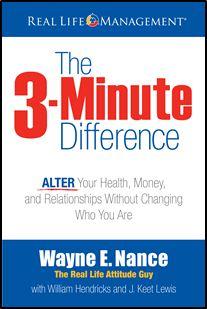
The 3 Minute Difference by Wayne E. Nance

I tell people all the time, it really isn't that hard to change your life and reach your goals if you are willing to make little changes.  That is the focus of this book.

Before I read the book, I took the quick survey in the link I received from the Publisher.  Point number one you should note... it really is quick.  I did it from my smart phone while nursing the baby.

Point number two... Usually those things are so very far off.  But I was shocked when this one got me dead on.

We are not all the same.  We don't all like the same things.  We all don't work the same.  When we try to fit into someone else's mold we end up feeling miserable and setting ourselves up for failure.  Often I think we find it difficult to make changes in our life ecause we are trying to do what works for someone else.  And sometimes that will work for us.  However, it isn't always the case.  By knwing who we are and how we work best we can set a plan for our life that will actually get us where we want to be.  Wayne Nance takes that into consideration.


It is time for a FIRST Wild Card Tour book review! If you wish to join the FIRST blog alliance, just click the button. We are a group of reviewers who tour Christian books. A Wild Card post includes a brief bio of the author and a full chapter from each book toured. The reason it is called a FIRST Wild Card Tour is that you never know if the book will be fiction, non~fiction, for young, or for old...or for somewhere in between! Enjoy your free peek into the book!

You never know when I might play a wild card on you!


Today's Wild Card author is:


and the book:

Mission Books; New Edition edition (July 1, 2012)

***Special thanks to Rick Roberson of The B&B Media Group, Inc for sending me a review copy.***

ABOUT THE AUTHOR:


Wayne E. Nance, better known as the "Real Life Attitude Guy", is the well-known developer of the ABCs of getting your life under control. He is founder and CEO of Real Life Management, Inc. With his help, more than 50,000 struggling people have successfully improved their lives and given Wayne credit for helping them do so. Top corporations, the U. S. Army, organizations, and churches throughout the United States also use the Life Management system for the benefit of their employees and leaders. Wayne has been called Dr. Phil Foxworthy, a funny guy with a serious message.

Today, Wayne is a highly respected speaker, trainer and author of The 3-Minute Difference, Mind Over Money and Liten Up for Life. He previously hosted "The Real Life Attitude Guy" simulcast on Dallas radio 570 (Fox Network) and is currently working to launch that programming on the Web. As president and CEO of Real Life Management, Inc., Wayne's life focus is to provide the education that he feels has been insufficient in matters pertaining to health, finance, relationship building and how they are related.

Wayne lives in Texas with Shannon and their three daughters, Christel, Melissa, and Kara.

Visit the author's website.

SHORT BOOK DESCRIPTION:


Are you overweight, broke, or headed for divorce? Even one of these problems can be personally devastating. But what if you're facing all three at once? Years ago, Wayne Nance's life was out of control.   An incessant smoker, he weighed 315 pounds.  His marriage was disintegrating and his finances were bottoming out.   He finally realized that his obesity, debt and relationship meltdown were surface problems resulting from his core attitudes and beliefs. In The 3-Minute Difference, Nance describes his journey back from the ragged edge of reality to a healthy, productive life. His personal journey uncovered a proven solution-a solution that can alter your health, money, and relationships in only three minutes.

The 3-Minute Difference is about more than just weight, money, and marriage. With the five insightful steps Nance offers for ALTERing your attitude, you can apply these principles to any area of your life that is out of control. Nance thoroughly explores each step, defining and explaining them in detail. Readers will come away with surprising, perhaps first-time ever insight into their own core attitudes and how they impact their beliefs and choices. The 3 Minute Survey is a valuable tool to use in improving life in the areas of finances, relationships and health. The 3-Minute Difference shows you where to start and then gives you a plan on how to get there."


Product Details:
List Price: $16.98
Paperback: 320 pages
Publisher: Mission Books; New Edition edition (July 1, 2012)
Language: English
ISBN-10: 1618431188
ISBN-13: 978-1618431189


AND NOW...THE FIRST CHAPTER:


INTRODUCTION A Crisis in America


I want you to let your mind indulge in a little bit of fantasy for a moment.   Imagine yourself in a very successful career.  You’re making quite a bit of money—well into six figures. You’ve got a gorgeous 6,000-square-foot home with a fancy pool and a water- fall in the backyard. Parked in your three-car garage is an imposing Mercedes-Benz sedan. On your wrist is an enormous Rolex watch, the one with all the diamonds on it that dazzles everyone who sees it. Sound like a life you’d care to have?
It did to me. It’s the American Dream, after all. And in 1984, I had that dream and more. I was the kid from the poor side of the tracks who had raised himself up by his bootstraps, got a good education,  went to the big city, worked  hard,  and eventually met with success.
And you know what?  There’s not a thing wrong with that.  If that picture is similar to a dream you’ve always had, or a dream you’ve actually attained, I say, “Great! Don’t give up on that dream. Keep that dream alive.”
But know this: if you had seen me living that dream in 1984, you’d have said, “Wayne Nance has the perfect life.” But you’d have been dead wrong!  Because the truth is, my life was out of control. Meaning that I was making bad decisions that created serious long- term consequences for my happiness, health, wealth, and family.
Do you ever feel as if your world is spinning out of control?  A lot of us do in the post-9/11 world,  with  the economic  downturn that followed, the disaster of the stock market and the loss of many people’s  retirement funds,  the  ever-present  threat  of terrorist at- tacks,  the downsizing  of companies and  the offshoring  of American jobs, the erosion of values as corporate scandals have come to light,  and  so  many  other  things  that  make  us  worry  about  the future.
Those are serious matters, for sure. But did you know that there’s a crisis in America that actually affects more people on a practical, daily basis than any of those “world-class”  headline-grabbers? It’s a crisis that shows up all over the place but can be seen most graphically in three areas that all of us deal with every day: the lifestyle issues of food, money, and relationships. To put it bluntly, way too many Americans are fat, broke, and unhappy at home and at work.


Consider:
•   67 percent of Americans are estimated to be overweight or obese by Centers for Disease Control (CDC) standards.
• 85 percent of Americans will retire with Social Security benefits as their only means of support. In other words, they’re broke.
• 51 percent of Americans are divorced. Many others remain in marriages that might be called “psychological divorce.”
Clearly, something’s wrong in America!  Especially if you overlay those numbers on top of each other. Just imagine three pie charts showing the 67 percent of Americans who are overweight, the 85 percent who will retire virtually broke, and the 51 percent who are divorced.  Stack them on top of one another, and what do you see? That a lot of Americans are all three—fat, broke, and unhappy in their relationships. But that’s not the worst of it. The saddest thing is that many people struggling with one, two, or even all three of these problems don’t even think they have a problem!  Take obesity, for example. A 2004 Associated Press poll found that six people out of ten who qualified as overweight by government standards said their weight was just fine—healthy, even.
Or consider this observation from the national sales manager of a company  that  helps  small  businesses  and  individuals  facing bankruptcy work  out settlements  with their creditors:  “From  personal experience,  I see that  as people get further  into debt . . . they start making short-term decisions and don’t prioritize  their debt correctly.  Eventually, they start feeling overwhelmed, give up and go into denial.”1
What happens when someone goes into denial about their debt? They go deeper in debt.  They may also start eating.  Indeed, The Toque, a satirical Canadian website, imagines a VISA card issued by McDonald’s called (you guessed it) the McVISA. The idea is that people will be more likely to eat at McDonald’s if they can charge their Big Macs.
With that premise, the site invents twenty-two-year-old Josie Amblin, a student who uses her McVISA card at least ten times a week! “I can’t stop,” she confesses to a fictitious reporter. “It’s just so easy to purchase a burger and fries with credit.  I know I can’t afford to eat at McDonald’s this often, but I can’t help myself!”
Amblin racks up $2,100 on her McVISA card, even though it only has a $1,500 credit limit.
The whole story is a spoof, of course. But it hits the nail on the head. “I can’t stop! I can’t help myself!”  That’s the cry of someone whose lifestyle is out of control.   Someone who is making bad choices that will create serious long-term consequences for their happiness, health, wealth, and family.
In 1978, I was a poster child for being out of control in all three of the lifestyle areas I’ve mentioned. I weighed 315 pounds (that’s fat, by the way, even if you’re six feet, one inch tall). I was a financial advisor, but I had five credit cards maxed out. And at home, my wife, Shannon,  wasn’t exactly happy  with me because she and my daughter never saw me because I was too busy making  money for the family. At least that’s what I always told them (and myself): “I have to work this hard to provide for our family.” Yeah, right!
I was in total denial. I was caught up in a crisis that I didn’t even see. I was succeeding and making lots of money, and by society’s standards I was doing just fine. Only I wasn’t doing fine. You’re not doing fine when you can’t bend over and tie your shoes without being out of breath. You’re not doing fine if you’re giving great financial advice to other people, but your own financial condition is a house of cards just waiting to collapse. You’re not doing fine if you never spend time with your family because you’ve got to keep one step ahead of the hounds that are chasing you.
Because I didn’t have any boundaries, I let other people’s opinions determine my opinion of myself. I looked fine to them, so I thought everything about me was fine, too. But it wasn’t. My life was out of control.
Some people hit bottom and then finally wake up. I had to hit bottom three times before I woke up! (I’ve always known I was a slow learner.)  The first wake-up call came in 1978, when I was twenty-eight years old, with a beautiful wife, a one-year-old daughter, and another baby on the way. I was just at the point when a young man should be enjoying life to the fullest. Instead, my doctor was warning me that if I didn’t stop eating, I’d never see my fortieth birthday. Was that what caused me to change my ways? No! Guess what I did when I left his office? I headed straight across the street to a pancake house. I’m not kidding! And I charged the meal on a credit card. (You see, I do understand someone like Amblin!) So what was my first wake-up call? It happened during my annual visit to the “Big Men’s” store.  I was packing on so much weight that every year I needed new clothes—in the next larger size. You can imagine how embarrassing it was to make that trip. So it became my style to shift attention (and  blame) away from myself by complaining  about  the clothing manufacturers in Asia and how they were cutting their styles too small, or to joke that my wife was shrinking  my clothes in the washer.
But on one trip, when I started mouthing off, the old tailor spoke up. For ten years he had listened to my bull and said nothing. This time around he had had enough. He was getting ready to retire, so what did he care?  Right there in front of my wife, he turned to me and said, “It’s not your wife or the Taiwanese, pal. If you weren’t such a fat slob, you wouldn’t have a problem!”
I was stunned. I’d never been so insulted in my life. How dare him! Boy, was I ever mad! So I showed him. Why, I walked right out of that store without buying so much as a dime of new clothing!
But in truth, that guy did me a favor.  Because what he said was true. And it hit home. I was fat. Overweight. Obese. Whatever you want to call it, it doesn’t matter.  What matters is that I finally faced up to a cold, hard reality: my weight was out of control.
At some level I’d known that for years. But I had been in denial about it for years, too, really since I was a boy. You see, I come from a dysfunctional family on the outskirts of Houston, Texas (“dysfunctional” means you can get away with anything if you’ll just deny reality). Our family was the kind where Momma cooked everything in bacon grease. And if somebody  didn’t  have a third helping  of pie for  dessert,  she’d feel totally  offended.  But guess what?  In spite of Momma’s cooking there wasn’t a single “fat” person in the family. No, sir! We weren’t fat, we were just “big- boned.” That extra 50 or 60 or 90 or 100 pounds everyone was carrying was just the result of a “slow metabolism.” Just a “large thyroid.” And so Momma always told me that being fat just runs in our family. We had that “fat gene” going, don’t you know? (You see how denial starts early?)
With a background like that, it’s no surprise that early on I became the fat kid.  Eventually, the fat kid grew up to be the fat man. Only I wouldn’t admit that I was a fat man. I had all kinds of excuses to say I wasn’t. I was in total denial. “Justifiable denialism” is what I call it. I lied to myself to justify my poor decisions.  But the  scales don’t  lie, and  your  waist  doesn’t  lie, and  your  health doesn’t lie. And by the time I was twenty-eight I was getting sick and feeling tired.  And to be honest, I was sick and tired of being sick and tired.
So I did what almost everyone does when they finally accept the truth that they’re carrying too much weight: I went on a diet. In fact, I went on lots of diets. The grapefruit diet. The water diet. The low-carb diet. The six-meals-a-day diet. You name it, I tried it.
Sure enough, I lost weight.  And gained it back.  So I’d go on another diet, and lose weight. And then after I’d lost the weight, I’d quit the diet and I’d gain the weight back. Plus a little bit more. So I’d go on another diet, and lose the weight again. And then . . . well, you get the picture.
One diet I followed was Dr. Atkins’s first diet. He had two of them over the years. I tried the first one. He said if you ate about  as much  cheese and  eggs and  red  meat  as there  are  in the  state  of Texas,  you’ll lose weight.  I tried that and I did lose weight.  I lost about forty or fifty pounds, and pretty quickly.  But then I was diagnosed with a fissure tear in my colon, because I wasn’t eating any fiber or carbohydrates.
Surgery laid me up for a month.  And while I lay in that bed, I said to myself, “If I ever stop bleeding and get out of this bed, I’m going  to  learn  something  about  nutrition,” because  I had  never learned anything about it in school. I had been an athlete, but in my day the people in charge just said, “Eat chicken-fried steak, Wayne. You need something that’ll stick to your ribs. Don’t worry about the gravy. You’ll run it off.” I knew nothing about nutrition, food supplements, or how to balance my diet.
So when I got well, a friend told me about a book by Covert Bailey titled, Fit or Fat? Boy, was that a lucky break!  Bailey had a great concept: fat makes you fat. That was in 1979.  Amazing, isn’t it? Fat makes you fat. When  I read  that,  I realized  that  about  98 percent  of what  I was eating contained fat. I also discovered that when I wasn’t eating fatty foods, I was eating Oreos and chocolate milk and stuff that was loaded with sugar.
Bailey opened  my eyes to a lot,  and  I was shocked  to learn how  much  I didn’t  know  about  nutrition. After that, I couldn’t learn enough about it. I got really serious about what I ate, and I lost more than a hundred pounds over a two-and-a-half-year period.  All of a sudden I was the new thin guy. The 205-pound guy instead of the 315-pound guy.
So I’d gotten my life under control, right? Not exactly. I was only focusing on my weight. My spending was still out of control. Which means my work habits were out of control.  At 205 pounds I wasn’t  spending  any  more  time  with  my family  than  when  I’d weighed 315. I’d gone from being a big, fat, broke man with a lot of stress and an unhappy family to a thinner broke man with a lot of stress and an unhappy family.
Fast forward to 1984. By then, as I’ve said, I was making quite a bit of money.  I had the house, the car, the watch, the American Dream.  I sincerely thought I had it made. And I was thinner, too.
And yet . . . what difference does it make if you live to be one hundred if you’re miserable?  I was miserable.  I went through tremendous mood swings and depression.  I thought, “How can I be depressed when I’ve got it all?”
About that time I went on a trip to Philadelphia. I was now in insurance, and a very large insurance company wanted to honor me as one of its top ten salespeople in the country.  Quite an honor!  As I was riding on the bus from the airport to the hotel, we stopped at a red light downtown. I looked over and saw a big Catholic church. Suddenly tears started coming down my cheeks. I felt terribly sad. “I really don’t want to go to that hotel,” I was thinking.  “I just don’t want to go. I don’t want to be honored. I don’t want anybody giving me an award for being a guy that’s a workaholic who never sees his family, who just focuses on his money, his Mercedes, and himself. I feel very fake. I don’t feel good about this at all.”
But soon I was dropped off at the hotel.  Sure enough, I had my big private suite, all decked out with a complimentary fruit basket and a bottle of champagne. That was kind of cruel in a way, because I didn’t have Shannon there to enjoy it with me. The fact is, she had declined to come to the convention. She didn’t like being with me at that point in my life, because I was pretty much a jerk.
So there I was, the big shot in his big fancy room—all by his lonesome for a whole week. And boy, was I lonesome! So one day, right in the middle of the convention, I walked out of that hotel and went and found that Catholic church.  I’m not Catholic,  but I went inside and  ducked  into  a pew and  got down  on my knees,  and  I cried out to God: “Help  me understand why I’m so miserable!”
I didn’t really know what to expect. Nothing happened right away.  I finished the convention, collected my award,   and went home. About a week later, Shannon  told me that our girls’ elementary  school  was having  an open  house,  and  she wanted  me to go and  meet their  teachers.  I was still feeling kind of depressed, so I said I didn’t want to meet any teachers.  But for some reason I relented and went anyway.
My older daughter’s fourth-grade teacher had asked the students to make posters in answer to the question, “If you could have three things in your life, what would you want?” I looked carefully at the artwork arrayed on the bulletin board. Of the thirty-two kids in that class, twenty-six of them had drawn as the top three things they wanted out of life: more money, a sports car, and a big house.
Suddenly a light went off in my head. It was my second wake- up call. I thought about  those posters all the way home—driving in our Mercedes-Benz  to our six-thousand-square-foot home, driving past the other  six-thousand-square-foot homes in our subdivision, each with a Mercedes-Benz or sports car in its three-car  garage. By the time we arrived I had clarified my thinking.  “You know what?” I told Shannon.  “I’m miserable. I’m miserable because I’m trying to keep up with the Joneses, and I never wanted to be a Jones to start with. The worst of it is that we’re sending that message to our kids, and it’s the wrong message.”
Within  a year of that  night,  we sold the house,  got a smaller house in a different  neighborhood, I traded  in the Mercedes  for a pickup,  started  wearing  cutoffs,  and  got a Mickey  Mouse  watch made  of plastic.  I said to myself, “I don’t know where I’m going from here, but I’m going to refocus.” And in that  way I came to grips with  the fact that  my financial  lifestyle was out  of control, and  I needed  to  start  dealing  with  the  money  issue,  just  as  I’d worked  on the weight issue.
But I wasn’t out of the woods yet. Far from it. In 1992 Shannon and I hit rock bottom in our marriage. Remember,  I’d been in denial for years thinking  that  if I just provided  a nice lifestyle for my family,  they’d think  I was great.  Sure, we’d downscaled to a more modest home and all, but I was still providing well for my family.
But  one  day  Shannon   finally  decided  to  cut  to  the  truth. “Wayne, you’re basically a jerk,” she said. You can see that people sometimes have to shoot pretty straight in order for me to “get” what they’re saying.
At first I felt terribly defensive.  “Look at all I’ve done for you!” I thought to myself. “Look at all I’ve provided for us! Just look at all I’ve managed to accomplish in my life! Why, don’t you realize you’re talking to Wayne Nance here?”
But she was firm and clear: “I hate to tell you, Wayne, but you’re just a jerk. I don’t like you. And I hate to tell you the truth, but your kids don’t like you very much, either.”
That was yet a third wake-up call. Somehow the thought that the four people I cared about most in this world didn’t like me very much got my attention. “This isn’t working well,” I thought. “I started out fat, and I fixed some of that.  Then I started chasing money, and I fixed some of that. Yet now my family doesn’t like me very much. I think I better take a long, hard look at myself.”
So I did.  I went for counseling and had a lot of discussions over a long period of time. I came to grips with the fact that life is complicated. You can fix one thing about yourself, but that may only lead to problems with other things. The real question is, what’s driving your behavior? What’s the underlying  thing that’s creating all the  surface  problems  you’re  trying  to  fix? That core thing is what you’ve got to go after.
It was at that point that I encountered a powerful truth:  there is more to managing one’s lifestyle than merely making “right” choices. You see, almost  all the diets, budgets,  relationship books, and  other  lifestyle advice I had  gotten  said that  if I just made the “right” choices, everything  would  work  out.  Just eat less fat. Just stay within a budget.  Just tell your wife you love her more.  Just show up at your kid’s soccer game. Just count to five when the annoying person at the office pushes your buttons. Those were all the “right” choices. Do those and you’ll get your life under control.
Problem is, I’d made a lot of those “right”  choices. But my life still was not working.  Worse yet, I was having to put enormous energy into making “right” choices. So much energy, in fact, that if I let my guard down for an instant,  or if I felt tired or down or angry or whatever,  I’d just blow off my resolve and do it the old way— order  that  extra  meat patty  and the double  fries, buy that  tie that cost twice what  I intended  to pay, take on that  extra  speaking  engagement even though  I’d promised  Shannon  I’d be home that weekend.  Clearly, something else was contributing to my behavior besides making “right” choices, important as those were.
That’s when I encountered this breakthrough truth,  the truth that allowed me to start getting my life under control: most of what causes us to make the lifestyle decisions we make is not our choices, but  our  attitude  and  our  beliefs.  By attitude I mean the inborn “wiring” that we brought with us into the world.  Our attitude has to do with our basic outlook or orientation toward life, what we focus on, what matters to us, what we put our energy into. Attitude makes the biggest difference in our behavior.  Later in the book  I’ll take  you  through a simple  3-Minute  Survey that  will show  you your attitude, and I’ll tell you where you can get more information about  your “hardwiring.”
When I learned that the core of my lifestyle problems was my attitude, I started on a journey that continues to this day. I wondered, “Am I the only person in America who is struggling with food, money, and relationships?” What I discovered shocked me.
I began going to health spas and fitness centers, where I traded speaking and training for the opportunity to interview spa participants.  That gave me lots of firsthand data about the issues people really struggle with.
I found that millions of Americans are in crisis in those three areas.  In addition, I discovered that there is a link among those three issues—obesity, debt, and divorce. The link is people’s underlying attitudes. I discovered that certain attitudes are especially at- risk for obesity, debt, and divorce.  In other words, many of the same people who struggle with their weight and other health issues struggle with their money and related financial issues, and also struggle with their relationships, both at home and at work. They struggle because of their attitudes. And sadly, they don’t even realize that their attitudes are leading to self-defeating and self-destructive behaviors!
Would you like to know whether you (or someone you care about) are one of those people? Better yet, would you like to know how  you  can  regain  control  over  your  lifestyle,  no  matter  what your wiring may be? This book will help you do that.
First it will help you understand your attitude and how it affects everything you do and every decision you make.  Then it will take you through the same five-step plan that helped me lose more than a hundred pounds and keep the weight off for more than fifteen years.  The  same plan  that  helped  me pay off my five credit cards,  so that  today  Shannon  and  I live debt-free.  The same plan that has allowed Shannon and me to stay married—and increasingly happy—for thirty-one years.
Now let me point out that I have not written this book on my own.  This is a joint venture between me and my co-authors, Bill Hendricks and Keet Lewis. We decided  that  we would  write  the book  from  my  perspective,  using  the  first-person   singular  (“I,” “me,” “my”). But rest assured that this book expresses a common understanding among three partners. Indeed, Bill and Keet will tell you that they, too, have felt out of control at various times in their lives. They use this program daily to better manage their lives and businesses.
Bill understands the challenge of keeping life in balance, having lost his wife to breast cancer several years ago, and single- parenting his three daughters in their adolescent and teen years. Meanwhile he has headed  a consulting  practice  that  uses the phenomenon  of giftedness  to  work  with  businesses,  nonprofits, and churches to manage their strategic “people issues,” and with individuals seeking career guidance.
Keet has an extensive background in managing companies spanning several industries.  Today he is a busy entrepreneur with a variety of business and charitable activities.  He teaches the concepts in this book in his consulting work with companies, schools, and religious organizations. Like me, he has struggled at times with his weight and finances, and he has personally witnessed the success of our program.
Others have also contributed to the ideas presented in this book.  I’ve mentioned Covert Bailey’s influence on me. Keet first learned about attitudes from his friend, Zig Ziglar, who taught him that attitude is everything.  As Zig so aptly puts it in his foundational work, See You At the Top “Your  attitude determines your  altitude,” and  that  “we  can  Alter our  lives by Altering  our Attitudes.”
Keet began  his personal  dedication to understanding behavioral  science when,  as the CEO  of a manufacturing company,  he studied  and  applied  the principles  relating  to temperament as explained  by bestselling author Dr. Tim LaHaye  in his classic work, Why  You  Act  the  Way  You  Do.  Dr.  LaHaye wrote many other books on temperament, and they are a must read for any serious student of the subject. Additionally, Dr. James Dobson, Dr. John C. Maxwell, Dr. Steve Farrar, Dr. Howard Hendricks, Dr. Bill Bright, Josh McDowell, Dennis and Barbara Rainey, Dr. Tony Evans, Rich DeVos, Dr. Ron Jenson, Dr. Jack Graham, Judge Paul Pressler, and Bill Hawkins have all contributed much to our understanding of life- style issues like parenting, personal responsibility, and leadership through their very insightful writings. All of them have helped to lay a foundation for our work at Real Life Management.
Keet, Bill, and I hope that this book  will be a helpful complement  to the work  of people  like Bailey, Ziglar,  LaHaye,  Dobson, Maxwell, Rainey,  Jenson,  and  others  who  have pioneered  in the field of attitude and lifestyle management. Above all, we want this book to offer hope.
If I was able to regain some control of my life, you can do the same, no matter how desperate you feel your life has become. I’ve helped countless people just like you over the years through my training  workshops and  seminars  at corporations, health  spas, financial planning  firms, universities,  churches,  and many other  settings. Almost all of the folks I’ve met have tried way too many of the quick-fix diet, budget, and relationship gimmicks on the market. Most of them were discouraged. A lot of them were desperate. Some had even given up.  “I’ll never change!” They said.  If that’s how you feel, I implore you to keep reading. Because I’m not going to ask you to change.
You read that right. I’m not going to ask you to change. The word “change” implies that you need to make a 180-degree turn- around and basically become someone other than who you are. I’ll never ask you to do that.  God wired you the way you are, and I’m fine with that. I want you to be fine with that, too. You are just fine the way you are! But I know you’re not happy with the way you live. So come on inside this book with me, because I’ve developed a proven strategy to help you turn your life around.